Showing posts with label War. Show all posts

Saturday, June 13, 2015

Panzer Leader


By Heinz Guderian

It isn't that I haven't been reading a lot of books lately, its just that I haven't had much inclination to write about them, and also, a lot of what I'm reading at the moment are the Poirot books so there would be quite a lot of repetion I think.

But anyways, here is a topical book for this blog, and quite a good read it was too. Guderian comes across as quitea  sympathetic man, which might be surprising given his place in history, along side the rest of the German High Command of the Second World War, but perhaps less so if one is aware of the reputation of the Prussian aristocracy. In describing his actions during the war, one becomes aware of Guderian's humanity and his empathy, mostly to his soldiers, and to his fellow Germans is quite apparent. He keeps his disaproval of Germany's leadership in check, but it seems apparent that Guderian wants to be remembered as a soldier who did his duty to his nation, and to its people. This could be seen as an admirable character trait, and I make no doubt that it was probably what saved Guderian at the Nuremburg trials, but the sad fact is that this same devotion to duty by the German high command is what allowed Adolf Hitler to commit his nation to do unspeakable crimes, and to enter into a conflict they could not possibly hope to win.

Guderian does not shy from his share in the responsibility of Germany's fate, nor does he offer any feeble minded excuses. He explains the situation in a precise and clear fashion, starting in the late 1930's and continuing right through to the aftermath of the war. The middle of the book suffers slightly from this as the war on the Eastern Front is a long and tedious read full of place names one has never heard of, being fought over by units one is largely unfamiliar with (especially the Soviets).

Having said that, if your not interested in the history of the Second World War then this isn't a book for you. I slogged through the many pages of conflict against the soviets and was thankful I am merely a spectator to that horrific and ultimately pointless conflict.

To the end of the book, Guderian offers some interesting observations regarding Hitler and some of the other leading figures of Nazi Germany, and he puts the German High Command into a useful perspective, explaining how it came to be the way it was, historically speaking, and why it developed the way it did under Hitler. I for one, have a much better understanding of the way the Germany leadership functioned, and how and why it failed. Guderian doesn't hold back his punches. On the whole an interesting book though a little dry in the middle.
3/5


Wednesday, January 14, 2015

The Jabos

I love aircraft, especially low flying, high powered aircraft, preferably with two piston engines going at full whack (but I'm not fussy on the number of engines). Nothing in the air gets my juices flowing faster than a Mosquito or a Beaufighter at tree top height, rockets under their wings and all guns fully loaded.

Load her up boys!

Whats odd about the German's surprise regarding the Jabos, was that they originally coined the phrase to describe their own jagdbombers operating over south eastern England in 1942. 60 Fw 190s bombed Canterbury with only one aircraft lost, killing 32 civilians and injuring 116, in the largest raid since the Blitz. Flying at sea level, under the radar, these raids were hard to intercept (Source). Despite this, when the German forces encountered the Allies post D Day air superiority, they got a terrible shock. The following document, translated by American intelligence officers during an interogation sheds some light on how terribly effective the Jabos were.


"Something happened that left us in a daze. Spouts of fire flicked along the column and splashes of dust staccatoed the road. Everyone was piling out of the vehicles and scuttling for the neighbouring fields. Several vehicles already were in flames.

The men started drifting back to the column again, pale and shaky and wondering that they had survived this fiery rain of bullets. Had that been a sign of things to come? This had been our first experience with the ‘Jabos’

It dawned on us that this opponent that had come to the beach of Normandy was of somewhat different form. The march was called off, and all vehicles that were left were hidden in the dense bushes or in barns. No one dared show himself out in the open anymore. Now the men started looking at each other. The first words passed. This was different from what we thought it would be like. If things like this happened here, what would it be like up there at the front? No, this did not look like a feint attack upon our continent. It had been our first experience with our new foe — the American."

Saturday, January 10, 2015

Black humour from the Red Baron


Some rather dark quotes from Manfred von Richthofen;

As a little boy of eleven I entered the Cadet Corps. I was not particularly eager to become a Cadet, but my father wished it. So my wishes were not consulted.

I never was good at learning things. I did just enough work to pass. In my opinion it would have been wrong to do more than was just sufficient, so I worked as little as possible.

All the papers contained nothing but fantastic stories about the war. However, for several months we had been accustomed to war talk. We had so often packed our service trunks that the whole thing had become tedious.

There were sometimes from forty to sixty English machines, but unfortunately the Germans were often in the minority. With them quality was more important than quantity.

Of course no one thought of anything except of attacking the enemy. It lies in the instinct of every German to rush at the enemy wherever he meets him, particularly if he meets hostile cavalry.

Now I am within thirty yards of him. He must fall. The gun pours out its stream of lead. Then it jams. Then it reopens fire. That jam almost saved his life.

One can become enthusiastic over anything. For a time I was delighted with bomb throwing. It gave me a tremendous pleasure to bomb those fellows from above.

In the heat of the Russian summer a sleeping car is the most horrible instrument of martyrdom imaginable.

It is a pity that my collection of trophies contains not a single Russian.

Everything depends on whether we have for opponents those French tricksters or those daring rascals, the English. I prefer the English. Frequently their daring can only be described as stupidity. In their eyes it may be pluck and daring.

The English had hit upon a splendid joke. They intended to catch me or to bring me down.
.

Sunday, March 30, 2014

Harry's War


By Harry Drinkwater

This is the real deal; a day to day diary of a British soldier who fought in World War One, and who took part in some of the biggest and bloodiest battles of the war, including the Somme and Passchendaele and who survived, more or less intact. Books like this are said to be rare, and I've certainly never come across one before, as it was against regulations for the soldiers to keep diaries lest their writings fall into enemy hands. Other soldiers wrote memoirs (and I'm reading one such now) but this is different in that it documents things as they happened. Drinkwater's account doesn't gloss over the boring bits, but records them, in all their seemingly dull detail. To get a clear idea of what the war must have been like, this is invaluable. There is no drama or glorification, either of the violence or of the horror. Drinkwater simply records events, and some of his own thoughts accordingly.

In many ways, this book reminded me of another; Trafalgar: an eye witness history, though there are some major differences, the most obvious being the difference in time. This book is also a single man's perspective, so you can only really see the war thorugh Harry Drinkwater's eyes. There isn't a lot of historical context offered as Drinkwater himself barely knew what was going on in the world beyond the battlefield.

This is an excellent book for any one interested in the First World War.
4/5

Wednesday, March 12, 2014

Beaufighter - Whispering Death, The Forgotten Warhorse

Following on from my previous post on Beaufighters;

)

Sunday, January 12, 2014

Vickers, Browning M1919 & MG-34; comparisons


Part 2. Part 3.

I have yet to see a You Tube video where an American admits his own nations fire arm is inferior to that of any other nation.
As far as I can see, the first comparison does not hold up very well at all, since the Browning was developed a good seven years after the Vickers and John Browning had the accumulated experience and knowledge gained from World War One at his disposal. In essence this is like comparing a Hawker Hurricane to an F-86 Sabre jet and when you take that into account then I think the Vickers equals the Browning, for all its perceived flaws.

As for the second comparion, I can't see that there is much to talk about. The M1919A4 did its job, but this is another unfair comparison  and when compared to the MG-34 (designed a full decade after the M1919) it is entirely out classed in just about every aspect. 


Part 2.

Tuesday, August 06, 2013

Camp Century


Interesting, not least as I've never heard of Camp Century, and I love the way the music shifts character when the narrative changes from Denmark to the US military. Camp Century was essentially a smoke screen for proposed nuclear missile launch sites. Watching this, makes me wonder what else might be buried up under the northern ice fields...

Project Iceworm

Monday, July 29, 2013

Waterloo


Dir: Sergey Bondarchuk.

I'd heard of this movie many times, but I'd never seen it. No television channel ever showed it where I've been living, despite the fact that I've seen 'Zulu' on terrestrial televsion at least four times (and twice on my computer). Since I'm not really into Napoleonic land battles, I haven't missed the film, but I have read once or twice, this was something worth watching, and after I'd watched 'Master and Commander: The Far Side of the World', the evening previously, I felt inclined to see 'Waterloo' when I chanced across the full film (and in reasonable quality) on You Tube.

Luckily I wasn't expecting miracles from a film made in 1970, so I merely chuckled at the actors doing their best to appear in character whilst on rocking horses with propane explosions going off behind them. Unfortunately the introspective tone of the film was not so funny, and I found myself rapidly losing interest every time the camera man fell asleep whilst watching Steiger struggle with a megalomaniac's inferiority complex. The film really sank when Plummer, playing Wellington, lapsed into the same timid voice overs.

The big battle, which dominates the second half of the movie, was rather disappointing too. The sheer number of extras (or cardboard cut outs) was impressive, but despite the odd innovative camera angle every now again, the action sequences had very little dynamic and appeared to rely almost totally on obscuring the picture with smoke rather than create a sense of ambience. When I consider this film with 'The Duellists', which was made seven years later with a much smaller cast, and probably a fraction of the budget, I can't but help thinking that here is a film in desperate need of a remake!


Sunday, July 21, 2013

Leaving Afghanistan


In a few days time, the last Danish troops will be leaving Afghanistan, concluding all Denmark's combat operations along side her allies. Counting the seven we lost in Iraq, Denmark has suffered fifty fatalities and many more wounded since 2001. The sight of young men in wheel chairs or with limbs missing is no longer a rare sight in Denmark and this visible sign of the cost of war, though it may seem insignificant beside that of the USA or UK, has begun to raise questions in Denmark. With our smaller population, fifty dead, and hundreds seriously wounded, even over so many years, leaves a mark. Some politicians have wondered if the war was worth the price, and one or two have come out openly against the methods used. Many Danes, especially amongst those whose political persuassion lean to the left, regard the entire war as evidence of American imperialism, and by extension, Danish culpability.

I also wonder if the war was worth it. I don't really know what the purpose of the war was, probably because it was never really a war, just ongoing combat operations against a group of people whose identity is almost impossible to define without violating politically imposed definitions. What was the connection between Iraq and Afghanistan? Iran? Islam? Nuclear proliferation in a region incapable of trustwrthy conduct?

Now these combat operations have come to an end, the question of whether we've accomplished anything at all seems pertinent. The debate will rage in Denmark for a long time to come I think, though I doubt any form of unified understanding will establish itself in my life time. We can't even agree on whether or not we can claim a victory. I suppose only time will tell as to whether or not the Taliban will reclaim Afghanistan.

For my part. Even though I am ignorant as to what the real political motivations of the war were. I appreciate the service, and the many, many sacrifices our soldiers have made on our behalf. I won't be voting for any politician whom I suspect of failing them. Either the living or the dead.


Saturday, July 20, 2013

U-20


There is a difference between looking at an old object and looking at an historical object. Especially if the object in question is associated with infamy. The first time I realised this, was in 1989 when I was standing inside the gas chamber at Auschwitz staring at a fake shower head. To say that I was touched with sadness would be an understatement. Auschwitz was indescribably dire and I shall never forget the sense of isolation it created within me.

Last week I caught an echo of that feeeing when I was at the St George Musuem and found myself standing in front of the conning tower of U-20, for U-20 was nothing less than the u-boat which sank the RMS Lusitania. See my previous post with regards to the museum.

The conning tower of U-20. The cycle beihnd it gives an indication of just how small the conning tower is.

---
Standing next to the conning tower of U-20 was the 105mm deck gun from U-59. According to the infomation plaque, this gun had spent eighty eight years in the sea. It was in a remarkable condition considering.
A copper plate on the side of the gun reads Nr 823. Fried. Krupp. 
The last of these four images is from inside the U-20 conning tower and shows where the periscopes were.

Lusitania was an ocean liner belonging to the Cunard line, and she was launched in 1906. At the outbreak of the First World War she was commandeered by the British Admiralty to be used as an armed merchant ship. She was no good for this however so the Admiralty released her back to Cunard and she resumed her previous rolé as a trans-atlantic passenger ship. On 7 May 1914, as she returned from New York, she was torpedoed just 11 miles off the southern coast of Ireland. 1,198 innocent people were killed. It is said that this incident went a long way to convincing the citizenry of the USA to accept participation in the war, and as the poster image at the top of this post illustrates clearly, the authorities were not shy about using the tragedy to encourage men to sign up and fight.

Standing in front of the rusty old conning tower, on a sunny summers day in Denmark I caught an echo of that same feeling I'd had in Auschwitz so many years before. Here was an historical object, and an object of infamy to boot. I'd had no idea that the U-20 had beached itself at Vrist (where we'd been sleeping in a summer house) for there are no monuments out there and no wrecks to be seen, just the endless flat beach of west Jutland. Even if I'd known about the wreck, I didn't know the number of the u-boat which had sunk Lusitania. Reading the little descriptive plaque which stood in front of the conning tower then, I felt a cold surprise when I realised what I was looking at.

In a way it was a poignant feeling in more ways than one though. There was the empathic feeling for all those innocent people drowning in the cold, dark Atlantic, and a natural abhorence at what men will do to each other, and even to women and children. At the same time there was a weary resignation that when all is said and done, here was a rusty piece of historical flotsam, left to attest to the futility of all the conflict and suffering which we as a species must endure. I often feel the same way when I chance upon a sun bleached crab's carapace, lying on a beach. Once it was a creature that breathed and lived. Now it is just an empty reminder of our inevitable mortality. I am moved to suppose that our only salvation lies in the meaning we give to our lives as we live them, and there can't be much purpose in slaughtering innocent people. I am glad to be so fortunate to live in happier times! 

As for the innocent passengers of Lusitania, and the many other victims of u-boat warfare, and even those poor submariners themselves, so many of whom paid a terrible price for their loyalty to their country. If we have souls, may they all find peace, where ever they are now.
 

--
Inside the museum was a scale model of a u-boat, done all in wood. Its worth adding to the post simply because it was so impressive.


Sunday, March 24, 2013

Looking at 20mm

After a break of several weeks, we're gradually building up to resuming regular gaming, and though it will never really be the same without Oleg, hopefully we can make some decent games and have some fun. I'll be running a short RPG campaign in the meantime, but Palle is looking to run a 20mm modern campaign, set in Africa and featuring mercenaries (I'm thinking 'Wild Geese' or something similar). I like the idea of doing modern games in 20mm as it gives you the additional option of using 1/72 scale vehicles, which I think are more available than in 1/55 or 28mm.

So I've been looking at manufacturers and idely pondering whether or not to branch out to 20mm, even though I know I probably won't as I've already invested so heavily in 28mm. Still... its tempting when you see what some people have accomplished.

Thursday, February 21, 2013

The Grand Duke


By Berthet Yann and Romain Hugault

This graphic novel was recommended to me by my friend Andreas, who assumed (correctly) that I might like it.
In three parts, combined, this is a story revolving around two fighter pilots on the Eastern front, one a German man and the other a Russian woman. Both go through various trials by combat in differing aircraft and it isn't hard to see how much Romain Hugault loves his aircraft! (Examples of this can be seen on his blog).
The story itself is not as interesting as the images, but it does the job. There are the usual post-modern dissaociations to contemporary political ideologies, with both pilots demonstrating contempt for their own political leadership, but given the awful times in which the novel is set, this is probably necessary for a modern audience to appreciate the unlikely romance which evolves between the two. Most of us need a means by which to suspend our disbelief after all.

The art work is very well done, with meticulous attention to the technical aspects of Second World War aviation (though I spy an understandable emphasis on the German aircraft) and there is no end of details for aeroheads to obsess over. The images appear to be hand drawn line art, coloured in photoshop, and are technically much the same as some of the images I've done in the past. These are just far better than anything I've produced and are so obviously a labour of love that its imposible for me (not least as a aeroplane fan) to not like them.


Thursday, January 03, 2013

Sergeant René Brink Jakobsen


Killed in action in the Upper Gereshk Valley, Helmand. Wednesday 2nd. 2012. Sergeant 1st Class, René Brink Jakobsen is the first Danish soldier to fall in Afghanistan since 2011, and the first ever Danish Jæger to be killed in action. He is survived by his wife and three children. May his soul rest in peace and I hope his family can find some solace in the sacrifice he made on behalf of his country. 

Edited to add;

British Army Warrant Officer Class One (WO1) Andy Peat awarded Anders Lassen Award from Crown Prince Frederik.

Sunday, November 11, 2012

Interesting people; Adrian Carton de Wiart

Heres a little light reading for Rememberance Day. Sometimes, its tempting to believe ridiculous stereotypes are based on something other than simple prejudice, and if that happens its good to have an example that blows the stereotype clean out of the water. If for example, you ever found yourself believing Belgians were a sort of peaceful people, averse to the idea of war, or just plain 'yellow', then meet Adrian Carton de Wiart.


Born in 1880, de Wiart came into being, at just the right time to participate in the most bloody and brutal wars of all time, get wounded and maimed in all of them, and thoroughly enjoy himself in the process. Its not a stretch of any one's imagination to suppose, de Wiart may actually have been a right nutter, or perhaps he was a reincarnation of an ancient war god, but what ever the reason, history records how Adrian Carton de Wiart, supposed illigimate son of King Leopold II (the bad king of the Congo), joined the British army (underaged of course) and went to the Boer War in 1899 where he was duly shot in the stomach and groin.

This kind of wound would put most modern soldiers into therapy for the next few years, but for de Wiart it was merely a taste of what was to come, and he was hungry. He quickly swore allegience to King Edward VII of Great Britain and as a career officer in the British Army was ready for action when the Great War kicked off. Actually, de Wiart was already at war before the Great War kicked off as he was in British Somaliland fighting the Mad Mullah (they had them in those days too) where, on an attack at Shimber Berris, he lost his left eye. Not thwarted by the difficulties of monocular vision, de Wiart made it back to Europe and got stuck in to the western front. Over the course of the next few years he was wounded seven times, eventually losing his left hand and taking a bullet to the skull (and one to the ankle) at the Battle of the Somme, another through the hip at the Battle of Passchendaele, another through the leg at Cambrai, and another through the ear at Arras. When he published his memoirs, and disregarding the fact that he'd won the VC during the conflict, de Wiart wrote frankly that he'd enjoyed the Great War.

De Wiart was awarded the Victoria Cross for his actions on the 2nd and 3rd July 1916, at La Boiselle, France. The citation reads;

For most conspicuous bravery, coolness and determination during severe operations of a prolonged nature. It was owing in a great measure to his dauntless courage and inspiring example that a serious reverse was averted. He displayed the utmost energy and courage in forcing our attack home. After three other battalion Commanders had become casualties, he controlled their commands, and ensured that the ground won was maintained at all costs. He frequently exposed himself in the organisation of positions and of supplies, passing unflinchingly through fire barrage of the most intense nature. His gallantry was inspiring to all.

The mid-war period was a bit slow for de Wiart but he found time to amuse himself  in Poland in 1920. When the Red Army was at Warsaw, de Wiart was acting as an observor for the British government and in July of that year found himself on a train being chased by Red Army cavalry. Undaunted by the communists he took to shooting at them from the running board with his revolver.

As we all remember, Nazi Germany invaded Poland in 1939, and you can probably guess who was still in Poland at the time. Still an observor, de Wiart offered his advice to the Polish commander but was largely ignored, and as Poland fell, he was obliged to flee the country with the Luftwaffe shooting up his car as he left. He arrived in Rumania but again, was forced to get out by the skin of his teeth as the Rumanian fascists assassinated the pro-Allied prime minister.

Still a Colonel in the British army de Wiart went to Namsos in Norway with the Anglo-French forces, but on his arrival his plane was shot up by a Luftwaffe fighter. De Wiart survived but his aide was wounded and had to be taken back to the UK. The French decided to stay in Namsos, which was being bombed by the Luftwaffe, but de Wiart took his British unit to Trondheim Fjord, where they were shelled by German destroyers. With no air support, artillery or reinforcements, the British were being out flanked by the Germans. De Wiart knew the game was up in Norway but despite constant air attacks, held on to the last moment.

After the disaster of Norway, de Wiart was appointed as head of the British Military Mission to Yugoslavia. He flew there in a Wellington bomber but was shot down off the coast of Libya by the Luftwaffe. Captured by the Italians de Wiart was eventually sent to a special prison for senior officers at Castello di Vincigliata. After five escape attempts (including a seven month tunnelling effort) de Wiart was released as Italy tried to get in bed with the Allies. On one escape attempt de Wiart evaded capture for eight days disguised as an Italian peasant, which as Wikipedia notes, was surprising since he was in northern Italy, did not speak Italian, and was 61 years old, with an eye patch, one empty sleeve and multiple injuries.


Next, Winston Churchill sent de Wiart to China, but before he got there he attended the Cairo Conference (see image above where de Wiart is easily recognisable). On his arrival in China, de Wiart worked at the headquarters of the Nationalist Chinese Government until his 'retirement', returning home in December 1944 to report to the War Cabinet on the Chinese situation. After that he returned to Asia and (as a spectator, on the bridge of the battleship HMS Queen Elizabeth) he observed the bombardment of Sabang in the Netherlands East Indies. I'm guessing a naval bombardment by a dreadnought battleship with 15inch guns wasn't just another day in the office, even for de Wiart. 

After the war, de Wiart retired, but before he could get back to Europe, he slipped and fell down a flight of stairs in Rangoon, and broke his back. This put him out for a while, but he eventually recovered and in 1951, at 71 years old, he married a woman 23 years younger than himself (apparently he had a life long reputation for being something of a fox), moved to Ireland and lived the rest of his days in peace. He died of plain old age in 1963. Aged 83.

After a life time of loyal and active service, his will left £3,496.


Saturday, July 14, 2012

1930's turret designs


When I can find the time (and when I'm not being distracted by Battlefield 3) I'm still working on my medium tank casting project, and I've reached the post design stage for the turret. That is to say, I've drawn up my designs and am now ready for construction. My brother Peter (who is a precision engineer) has offered to help me by shaping some aluminium for the underlying structure, so I've made technical drawings of the two designs I have in mind. The project has two different hulls and two different turrets, and these can interchanged with each other, giving the possibility of three seperate tank models. The track assembly is the same for all variants.


Tank turrets in the 1930's came in all shapes and sizes. Since there hadn't been any major tank conflicts to influence design, many ideas which seemed good in theory were tried out. The most popular designs were cylindrical for obvious reasons, and hundreds of variants of the tapering cylinder or dome turret design were made. I've looked mainly to the Vickers designs for inspiration, since they produced so many prototypes in the mid war period.

--

Above. From left to right; Light Tank Model 1936. Light amphibious tank A4 E12. Vickers Wolseley WT
Below; Vickers 6 ton light tank. A6 Medium Tank (not to be confused with the Medium Mk III). Vickers 'Independent' A1E1.


Tuesday, June 19, 2012

Ghost Recon Alpha


I thought I'd posted this already, but looking through the post log, it seems as if I hadn't. So any way, here is a rather neat little promotional short film by Ubisoft. I can't say I am interested in their final product, but I do find this advertisment to be very inspirational.

Tuesday, May 29, 2012

B17 Bomber - The Mission


Apparently made for some kind of VR system... looks good.

Thursday, May 03, 2012

Red Tails


Dir: Anthony Hemingway and George Lucas

There is no way to polish this turd so I might as well get it out in the first sentence; this was a terrible film!

I was looking forward to seeing something spectacular, though not in the acting or directorial department. I was expecting really well made, seat-of-the-pants, cgi dogfighting with great soundscapes and plenty of good composition and art direction, the sort of stuff Lucasfilm are supposed to be good at. I was expecting to feel the vibration of the Merlin engines and smell of the cordite from six .50 machine guns. Instead I got glaring historical gaffs (The Red Tails placed on the Ploesti raid) and reason defing story telling (protagonist being hit by multiple 30mm rounds to the upper torso and still being able to speak).

I understood that with George Lucas attached, the acting, plot, etc would be bad, but I wasn't ready for just how bad it was. I don't think I've ever seen a contemporary war film with so many two dimensional characters, stiff as a plank dialgoue and such a monorail plot.

George Lucas should be ashamed of himself. Here is a story that demands respect. A story where you really have story tellers gold just waiting for you to pick it up. A squadron of black American pilots, battling domestic attitudes whilst fighting to the death against the most evil racists in history, and all the while flying the most iconic American fighter aircraft of all time. How could you possibly take that and mess it up?

And thats not even touching on the historical inaccuracies and unrealistic potrayal of air combat, the ineptitude of which reminded me of the cheap rubbish they made in the 1950's. If you want to know the story behnd the Tuskagee pilots, then The Tuskagee Airmen is the film that you should watch. It had a smaller budget, but it tells the story as it deserves to be told.  


Thursday, March 22, 2012

1936-39 Civil War In Spain


Here is some interesting coloured footage of the Spanish Civil War. Of all the 1930's period, I find this war to be particularly strange. It was in some way, a prelude to the World War that was to follow, but in other ways it reminds me of the Palestinian/Israeli conflict with its broad international and ideological appeal. As usual when ideologies collide, it was the women and children who paid the highest price of course.

Sunday, January 29, 2012

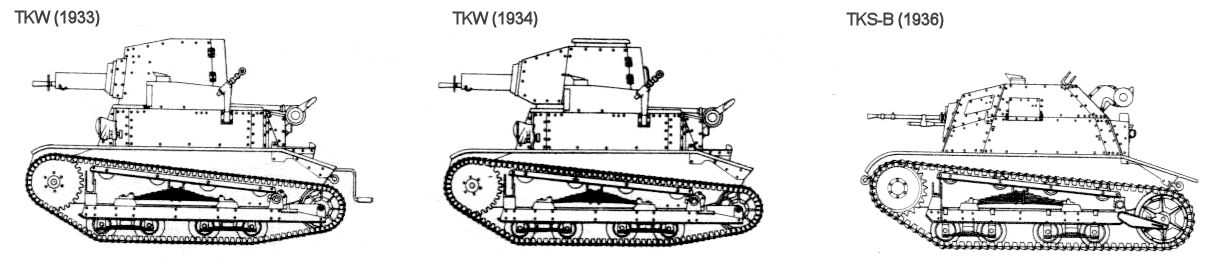
Polish TKS tankettes


I recently came across Warlord Games Polish vehicles and guns page where upon are TKS Tankettes for only £10 a piece. A bargain I thought since I didn't have any tankettes and immediately ordered two of them. Until that decision, I had never felt any but a passing interest in tankettes and if pressed I would only have been able to name one; the Carden Lloyd. My interest was piqued when I discovered the TK tankettes could be made with a 20mm anti-tank gun and then suddenly a whole range of options presented themselves.


The Poles were big on tankettes, and built 575 of the TK series, which was heavily based on the Carden Lloyd. These included a number of interesting variants, including gun tractors, tankettes with turrets and a tank destroyer armed with a 47mm gun (see photograph directly above). Unfortunately only four of those tank destroyers were made, so I have to make do with my two TKS tank destroyer tankettes. Thats okay though. I am in love with these diminuitive monsters having read up on their history. The Poles had planned four cannon armed units in every squadron (of thirteen tankettes), but production was interupted by the German invasion in 1939 and in the event, only twenty four were in actual service. Only a few cannon armed tankettes saw any action but of these, one really stands out. Officer Cadet Roman Orlik led a two tankette attack against a German panzer formation on 14th September, 1939.


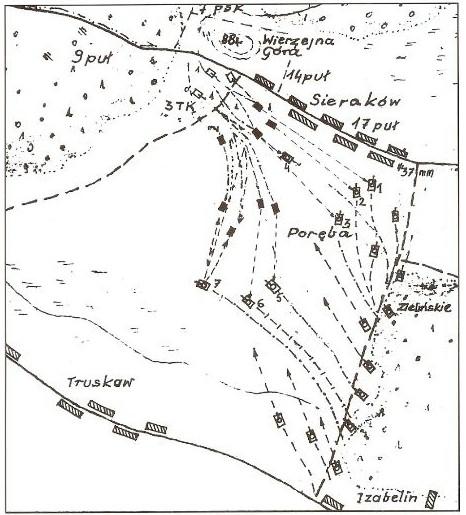
Orlik, who survived the war, later recounted his experience and drew several maps to explain what had taken place. In the first encounter, as shown in the image above, Orlik (who already had three Panzer kills to his credit) and his unit lay in ambush in an orchard. When three German panzers from Panzer-Regiment 11 of the 1st Leichte-Division came into sight, they took them out, firing into the German's flanks. The destroyed tanks were two Panzerkampfwagen 35(t)'s and a Panzerkampfwagen IV. The latter being commanded by a notable German aristocrat named Prinz Victor IV Albrecht von Ratibor, who was killed. The image below shows his tank


I'm actually surprised that a 20mm gun could take out a Panzer IV, but the gun in question, the Nkm wz. 38 FK, had been designed and built by the Poles for exactly this kind of tactic. The TKS being both small and agile, was extremely difficult to see too and the Germans probably never saw the Poles before they'd been defeated. The Nkm wz. 38 FK was an automatic cannon with a five round magazine and I wonder how many hits it took to destroy von Ratibor's tank. The damage seems extensive; the rounds appear to have gone right through.


The next day saw Orlik back in action taking on Panzer-Abteilung 65 of Panzer-Regiment 11. The second map shows how Orlik with only one other tankette from his unit (71. Armoured Dyon of Wielkopolska Cavalry Brigade), once again, defeated the 'superior German Panzers' using a series of well placed flanking shots. If you examine the drawing you can see the irony in the German advance, for they turned aside from the Poles, and exposed their weaker side armour. I wonder if they hadn't noticed the tankettes, with their low silhouettes, at all. Of the seven defeated German tanks, six are described as Panzer 35(t)'s. I don't know what the last one was, but it may have been a Panzer III or IV. The Germans lost a total of thirty eight tanks that day, and Panzer-Abteilung 65 was annhilated. Roman Orlik and his tankette went on to break through to Warsaw to help in the defence until Poland surrendered. In just a few days, he'd defeated thrteen Panzers in his tiny TKS and become Poland's first (and possibly only) tank ace of the war. Thats not too shabby for a fighting vehicle hardly bigger than a wheel barrow! Orlik was so cool, I think I might have to incorporate him into an RM game one day!

The image below shows you how small a TKS is next to a Panzer IV.


Top speed: 46 km/h
Range: 200 km on road. 100 km off road.
Crew: 2
Length: 2.58 m without the gun
Width: 1.78 m
Weight: 2.6 t
Power plant: 6 Cyl. Polski Fiat 122b (Petrol)
Armour: 4 - 10 mm.
As you can see in the diagrams below, the crew sat on either side of the engine. It must have been nice and warm when the tankette was running, but very cold when they were laying in ambush. The TKS carried 250 AP rounds for the 20mm gun, which comes to fifty magazines. Its not apparent on the diagrams where they stored them, but I'm guessing they were crammed in everywhere possible. Another important detail not shown is the periscope. The TKS were fitted with the Gundlach periscope which would eventually become the standard tank periscope for all the Allied forces as well as the Germans (who stole the idea once they'd realised how good it was).