Showing posts with label Goeg. Show all posts

Tuesday, March 04, 2014

RM12.1 The Return of the Black Guards


Conclusion 

This game was played on 22 February 2014.
Players were Jan, Andreas, Goeg and Palle.

For convenience, I shall refer to the left and right flanks as seen from the perspective of the map.

Both sides deployed across their edge of the table with the Black Guards (Palle and Goeg) deploying their tanks at once. Goeg positioned his first tank on the left flank, guarding the forest road, and he placed his second tank on the parallel road, facing towards the bombed out tank factory. Palle placed both his heavy tanks in the open ground of the far right flank, using the trees as partial cover and left his light tank to cover the ruins of the centre. Andreas placed his commander's tank in the trees facing Goeg's tank on the left flank. He left his second tank off map. Jan placed all three of his tanks in the centre ground of the railway siding. Palle and Goeg concentrated their infantry behind the central ruins whilst Jan and Andreas spread their infantry between the centre and left flank. Most all of Andreas' men were on the left flank.

Firing commenced with Goeg opening up a barrage against Andreas' forces on the left flank. Having established that the T-28 was impervious to his K4's guns, Goeg turned his attention to the infantry. He kept up a prolonged barrage that lasted for most of the game and which, despite their using cover to their best advantage, eventually annihilated a large proportion of Andrea's foot soldiers. Jan's Aglatean infantry hesitated for lack of movement points and were unable to move much from beyond their initial starting ground.

 Both sides held their ground cautiously for most of the first half of the game. Palle and Goeg were wary of the T-35's greater fire power, and Jan and Andreas were out numbered. The T-35 dominated the central ground but largely by default as it wasn't really being challenged. Eventually Goeg moved his second K4 heavy tank up the central road but Jan countered this with his light tanks, blocking the road and using the flame thrower tank to set fire to the tank factory building.

Palle edged his two tanks closer up the right flank in order to find a way of combating the T-35, but this was countered by Andreas who brought his second T-28 onto the map, behind the rail workers shack (not actually shown on the map as it was a later addition) on the far right flank. Trying to establish a lethal cross fire was very much the order of the day with both sides having difficulty bringing enough guns to bear to do any serious damage.

With both sides idling in an apparent Mexican stand off, Andreas then played his joker, a Polikarpov I-16 with six underwing rockets and twin 20mm cannon. He deployed his aircraft against Palle's tanks which were close enough together to bring them both within the rockets damage radius. Unfortunately Andreas rolled badly (both sides were plagued with poor dice rolls all day) and the joker failed. Palle continued to edge for a good firing position with both sides trading ineffectual shots across the right flank.

 Eventually Goeg brought his second K4 far enough up the central road to threaten the T-35 from the left. Palle brought both his tanks up and threatened from the right. It looked for a while as if the T-35 might be knocked out, allowing the Black Guards to secure the centre. Whilst this was happening however, Jan's two light tanks were moving in and around the centre with the twin turreted T-26 engaging the infantry who were trying to close on the storage building (even running some of them over) and the Kht-26 flamethrower tank moving right around the left flank to approach from the rear.

The game ended before either side could deliver a decisive attack and the end result was a narrow victory to the Black Guards, largely thanks to the initial bombardment of Andrea's infantry by Goeg's command tank on the left flank.

I think we had a good game and fun was had by all. I missed Oleg's presence, but in a way he was with us in spirit as the tank factory was one of his models I had completed, and then named after him. There will be a smaller follow up game in the next few weeks but Andreas was only with us for the one session unfortunately as he lives in Oslo. 

Sunday, January 23, 2011

Captain Fouquet; Chapter 1.3 'The Fire Bird' cont...

This game was played on 13 January. 2011.
Present were; Jan, Oleg, Palle, Goeg and Rasmus!!!

The game continued when Misteline and Marmaduke returned to Misteline's apartment where they found Silas who had come looking for his two associates Tom Hurdigrip and Gerald Mosscramp. Neither man had reported back to Silas and he had become concerned as to where they were. Misteline had nothing to tell Silas as he'd not heard from the men since he set them to work. Misteline then proceded to tell Silas what had taken place in the courtyard and how Rufus had come to be imprisoned. Since there were no other witnesses to the duel between Rufus and Franco besides Bagangelo, and since Bagangelo had subsequently been challenged to a duel by Captain Fouquet, Misteline proposed a contingency plan which involved paying some one who might be seen as a credible witness to play such a part. No stranger to respectable clients with large gambling debts, Silas agreed to the merits of the idea and promised to look into it.

Having agreed on their (illegal) plan of action, the three men decided to go to Mossmoore's Restaurant and Social Rooms on Cobblemoss Court, but only after first stopping by the Gentleman's tailoring establishment Van der Viir's to pick up some respectable clothing for Marmaduke. Misteline and Marmaduke went on ahead whilst Silas stayed behind to lurk in the courtyard and see if he couldn't catch some sign of Tom or Gerald. The courtyard was deserted however, and eavsdropping only told him that in one house (the Turnbull's) there was an argument in progress, but not apparently about anything of interest. Silas joined the others and Marmaduke was kitted out in silken undergarments and a plain but well cut outfit of martial design (in black and red). Properly attired the three companions made their way to the restaurant where they ordered food. Silas and Misteline enjoyed a well prepared White Fish whilst Marmaduke tucked into mutton dressed as lamb. Musical entertainment was provided by a small ensemble playing chamber music composed by the illustrious Jacoob de Vert.

Whilst waiting for their food to be served, Silas caught sight of Mister Devar Lockmyrtle, a respectable client of his, who just so happened to be in debt to the tune of 2,000 Crowns. Lockmyrtle saw Silas approaching and to the amazment of his companion Lady Witherspoon, grew some what agitated. He readily agreed with Silas that he would come to the Lotus Flower, the very next day, and there was no need to send any one to help him. Silas returned to the table where his meal was being served. During the course of their desert, several new patrons arrived from the Sun Theatre, including an old friend of Misteline, the actor and poet Alastair Heatherwax. Alastair sat with the companions and entertained himself at their expense for a while, especially Marmaduke chewing mutton whilst looking some what out of place in his painfully new clothes.

Whilst glad times were happening in the Armorial Quarter, Rufus was transferred by armed guard to the city's most formidable (and comfortable) gaol, the Bastion. Here he met an old man named Sir Walter Heraldlamb who had been convicted of debt and corruption twenty years ago and then left in the Bastion to 'rot'. Rufus quickly learned that life in the Bastion, for those who had money could be very lenient, and Sir Walter lived in relative luxury for some one who was supposed to be rotting. Arrangements could be made for food to be brought from outside the prison, visitors were allowed, including women, even prostitutes though not at night unless the woman was a wife in which case she might live with the gentleman so long as she desired. Sir Walter had already eaten but he gave his scraps to Rufus since it was too late to get anything else to eat. It was all a far cry from Mossmoore's where the chamber music had ended and a dancer named Salomé was performing with a snake, to the accompaniment of a Gypsey band. Full of wine and good food, Misteline, Marmdaduke and Silas each departed for home.

12 Marts. 1625.

Marmaduke awoke earliest but he was too slow to see the duel between Anton Fouquet and Bagangelo. He arrived just as the smug and chuckling Captain departed the field of honour, leaving behind him his two seconds to watch the progress of the horribly disfigured artist. Marmaduke pressed closer and saw that Fouquet had made three distinct cuts to Bagangelo's face and as a surgeon attempted to help the poor man, Bagangelo was kicking and screaming in pain. One cut had opened the bridge of his nose, another had lopped off an ear and the third had cut across both lips. Feeling some what sick, Marmaduke retreated from the grisly spectacle and met Silas who had arrived on a horse, accompanied by Tom and Gerald.

Silas paid scant attention to the wounded artist, as he had become aware of Fouquet's seconds, one of whom he was sure he'd seen some where before. He turned to Gerald and told him to stay close to the man and find out who he was. Marmaduke decided to return home and tell Misteline what had taken place, but Silas remained and noticed a fancy carriage off behind some trees. The carriage had no livery, but its presence was enough to pique his interest. Sending Tom to find the debtor Lockmyrtle and bring him to the Lotus Flower he himself followed the carriage back into the city and to the house of a notable member of the Royal Court, Sir Isambard Goatroll. Not familiar with Sir Goatroll Silas was unable to see if the man who climbed from the carriage was indeed the same man, nor did he recognise the lady in fine clothes who accompanied the man. Both were welcomed to the house by the staff as though they were well known, and no one exited the house to greet them. Silas returned home.

Maramduke returned to Misteline and told him what had taken place. Half way through their conversation both heard terrible screams coming from the tower abode of Anton and Anaïs Fouquet. Looking out the window, Misteline saw Meg Plum with three of the Cutlerstub children in the courtyard all looking up at the tower. Misteline decided to go to the apothocary Nicholas Rungate again and ask him to keep an eye open for any one who might be buying the same kinds of compounds as Captain Fouquet. Rungate promised to do this, but expressed doubt that such questions would lead to credible answers since a lot of people bought charcoal and stone salt. Misteline shrugged and inquired whether Rungate might not know of an accomplished surgeon, to which the apothocary replied in the negative.

Misteline went to Milners Lane to see Doctor Hamshank and ask him if he knew of a good surgeon. Doctor Hamshank did and promised to send a message to the surgeon to go and see to Bagangelo's wounds. Misteline then returned to the Friars Gate courtyard where he met and fell into conversation with Mrs Crimpstock and Meg Plum.

Devar Lockmyrtle was shown into Silas's room, sat in a chair and offered a glass of mediocre wine. Still trembling with fear he listened as Silas put forth the proposition where by Lockmyrtle, in exchange for leniency with regards to his debt, would stand forth as a respectable and upstanding citizen and testify that he was a witness to the duel between Rufus and Franco and that the duel had been fair and straight foward. Lockmyrtle agreed.

Once Lockmyrtle had left, Silas pulled on his coat, ordered forth a fresh horse and rode to the Militia offices in the harbour quarter. Here he met with his cousin, Axelrod Underhand whom he had helped install in the position of Captain of the Harbour Militia when he himself had been promoted to Tax Collector (see previous campaign). Since Axelrod largely owed his position to Silas he allowed him to look over the files pertaining to goods imports and Silas subsequently found that Sir Isambard Goatroll was a major importer of gin.

Sometime around midday, Rufus was briefly visited by Marshal Quartermoon who asked if all was well and if Rufus was comfortable and if he shouldn't find himself a servant to do for him? Rufus replied that he wished to speak with Misteline and before leaving Quartermoon told an aide to see to it.

Mean while Misteline and Marmaduke had run into each other in the courtyard and they decided to go and see if Bagangelo had returned home yet. On the way they happened to notice a distinct and bloody hand print on the upper window of Marcus Feathergate's house. Misteline immediately sent an urchin to fetch the militia and whilst he was waiting for the authorities to arrive, the artist went to see Hilda Grimbleflax and spoke with her for a while about 'doing something' about Anaïs Fouquet who it was assumed must be very upset about the duel.


Several Militia guards arrived shortly thereafter and Misteline pointed out the hand print. At first the guards were indifferent, but Misteline persuaded them to break into the house, and (by providing a small contribution to their purses) to take him with them. Within the house they found a mass of old furniture covered in dust coverings, and clear tracks from the doors to the staircase, and upon which they saw another bloody hand print. Upstairs they found the body of Marcus Feathergate.

Feathergate had not been dead for long and whilst the Militia guards searched for lucrative evidence, Misteline examined the body. He found the cause of death had probably been a large wound to the upper head consistent in character to the wounds suffered by Molly Cutlerstub. Most of Fathergate's face was a bloody, blistered mess, with everything burned away above his nose and a sizable wound in his forehead. Judging by the state of the bed, Feathergate had lain dying for more than two days. The Militia guards were not interested in the corpse except in as much as it wore a purse containing 200 Crowns.


Misteline examines the corpse of Marcus Feathergate

Having examined the body, Misteline then turned his attention to the room, plucking papers at random from the writing desk, before noticing two wooden chests. The militia opened the larger, only to find it contained clothing and articles of everyday use whilst Misteline dropped the smaller, locked chest out of the window to Maramduke who deftly avoided the attention of the distracted Militiaman guarding the back entrance to the house. Not long after this, a some what irate Captain Shallowsack arrived and had Misteline escorted from the building.

Misteline and Marmaduke returned to Misteline's studio to examine the contents of the small wooden chest, and as they did so, they noticed a stranger in dark armoured clothing watching proceedings from the archway of Captain Fouquet's tower. Shortly after the chest had been opened, Silas, and Tom, arrived and the three companions examined the neatly stored rolls of paper which were stored inside the chest. Each roll was tied with a wax sealed ribbon and upon breaking the seal, each roll proved to be a seperate cargo manifest of materials of war. Each manifest was dated and each was listed as the cargo list of a single ship. In the early papers the ship's name was always 'Molly Carbuncle', but in later papers a second ship 'Scarlet Jane' was named. The earliest paper was dated 1602 and the last was dated 1624. Seen as a whole, the chest documented the movements of enourmous amounts of war material.

A letter then arrived from Marshal Quartermoon it read;

"Have spoken with your friend, he needs a servant"


Rufus in the meanwhile was served with a summons to a Court of Law, on noon of the 15th of Marts.

Marmaduke eventually tracked down the crest used on the seal and printed at the head of each roll of paper in a book of contemporary heraldry from Misteline's private collection of books. It belonged to a small trading house called Treadstone. Silas recalled the name vaguely from his days as the Militia captain charged with maintaining customs and excise on the River Weyr. He decided to return to Axelrod Underhand's office and left with Tom.

Misteline and Marmaduke departed to speak with the lawyer Nathaniel Pennyfork, but diverted first to hire a man servant at the market. Whilst Misteline was hiring Horace Nuvel, Maramduke noticed they were being followed by the same man in dark armoured clothing whom they had noticed lingering in the Friars Gate courtyard earlier. Maramduke attempted to watch the man clandestinely but the man realised he had been observed. He moved further away but kept Misteline and Marmaduke in sight.

As the sun was dying in the sky Silas and Tom returned to Axelrod's office only to find he was not there. Silas bluffed his way past Axelrod's secretary to gain entrance to the archive room, but Tom ruined the effort by knocking the secretary out cold. Silas found a folder marked Treadstone, but within was only a single legal document stating that all papers pertaining to the House of Treadstone had been removed on the orders of Marshal Leander Quartermoon.


Rasmus made a rare appearance

Friday, December 17, 2010

Captain Fouquet; Chapter 1.2 'The Fire Bird' cont...

This game was played on 15 December. 2010.
Present were; Jan, Oleg, Palle & Goeg.

Misteline, Rufus and Marmaduke returned to Misteline's studio around an hour after night fall and tucked into a delicious fish prepared in wine sauce, served by the ever present Mrs Crimpstock. After the meal had been devoured and the plates had been cleared away, the companions set about theorising. Misteline expounded on his thoughts regarding alchemy and the purchase of alchemical materials, whilst Rufus advocated a thorough investigation of the mysterious Captain Fouquet. Marmaduke remain taciturn, watching the rain begin to form drops on the window.

Eventually, Misteline and Rufus decided to go and visit their former companion Silas Underhand whom they imagined might be able to assist their inquiries and shed some light on Fouquet's background. Marmaduke, who didn't know Underhand opted to remain in the studio and keep watch on the courtyard in case any further strange events took place. The first thing he noticed was the absence of the militia guard from the south tower door.

Silas Underhand was once a Captain in the City Militia, (See Campaigns 1 & 2) but who was forced out of his position by the change of regime and accusations of corruption. He survived these accusations and set up as the proprietor of the gambling house the Lotus Flower. As a consequence of his career, Silas has a great many contacts in the city's dark under belly.

Misteline and Rufus were admitted by the doorman and greeted by Silas in his chambers. Wine (of a mediocre quality) was served and Silas listened to Misteline's tale. Silas agreed to help in return for being in on any advantages Misteline's investigations unearthed (though Misteline was prudently vague about the mysterious cause of Molly Cutlerstub's death). Silas also agreed to lend Misteline the use of two of his associates. These were the muscular Mr Tom Hurdigrip and the sprightly Mr Gerald Mosscramp. Both men were at hand and accompanied Misteline back to his quarters. Rufus remained at the casino and gambled away some of his money.

Back in Misteline's studio, Marmaduke grew bored sitting in the dark. Two hours had past when he suddenly noticed two dark figures below. Two men in cloaks entered the courtyard from North Wall Street and paused to observe their surroundings at the rear of Meg Plum's house. Marmaduke realised the two men were in fact Meg Plum's lodgers, Cristobal Sebastiano and the man known only as Franco. He watched as the two men moved across his line of vision until they were obscured by the house of Robert Ladlevane. Cracking open a window he heard nothing until a few minutes later he became aware of voices and spied two dark figures standing outside the rear door of the Cock-a-doodle club confronted by the man named Franco who appeared to be threatening the two dark figures with a rapier. Marmaduke reasoned the two dark figures were paederasts and this conclusion was strengthened when both fled into the Cock-a-doodle club. Franco vanished from view. A few minutes later, several figures emerged cautiously from the gentleman's club and peered about the dark courtyard, then all disapeared back into the club.

Misteline returned home, accompanied by Tom Hurdigrip and Gerald Mosscramp, and Marmaduke told him about the confrontation with the patrons of the Cock-a-doodle club. Mosscramp immediately went down into the courtyard to investigate but found it deserted. Misteline then set Tom Hurdigrip and Gerald Mosscramp, to keep an eye on Cristobal Sebastiano and Franco, and both men then departed promising to report back on the morrow. Marmaduke retired to his own home and eventually fell asleep and Misteline sat by his window with a sketch book, musing.

Some time approaching midnight, just as he was beginning to fall asleep, Misteline heard dim voicees raised in argument. Putting his head out of the window he concluded that high above him, in the north tower, Anton Fouquet and his wife Anaïs were engaged in a domestic dispute. Not long after this Misteline observed the old captain leave the north tower and enter the south tower.

11th Marts. 1625.

Misteline was awoken by Mrs Crimpstock bearing his breakfast on a tray. It was sometime after 8 o'clock and outside, it was raining. After breaking his fast Misteline made his way to visit Meg Plum. Surrounded by Molly Cutlerstub's many children, including Nicolet Cutlerstub, the old char lady listened as Misteline expressed his sympathies (and offered a few Crowns to ease their pains). Misteline was interested in understanding Molly Cutlerstub's movements and moods in the days preceding her demise, but the family were unable to help. They had not noticed anything unusual in Molly's daily routine, certainly nothing they could connect with her death. The only detail Meg was able to recall was Molly's reticence during the evening of her last day.


Click to enlarge

Disapointed, Misteline asked the family to keep an eye open for anything untoward and then left Meg Plum's house, making his way along Garnet Street to Cobblemoss Court which he found full of people going about their business. Here he bought a copy of The Gentleman's Companion (one of the many single sheet Journals of Public Record which are a popular source of news and social comment in Takshendal) and found to his amazement that not only was Molly Cutlerstub's death the head line story but the journal was also reporting his involvement in the affair and the existence of an unnamed prime suspect (presumably Marmaduke).

Marmaduke in the meanwhile had awoken and gone looking for Misteline, but in crossing the courtyard had met Robert Ladlevane ignoring the rain and washing his head in a bucket of water. He also saw Anaïs Fouquet exiting the north tower with a wicker basket and head out onto North Wall Street. Marmaduke stayed and chatted with Ladlevane for a while then looked in on Mrs Crimpstock, and then Meg Plum as he followed Misteline's trail.

Independently of each other, Rufus and Marmaduke found Misteline standing in Cobblemoss Court engrossed in reading The Gentleman's Companion and since neither had yet eaten, they dragged him into the Red Fox for coffee and pastries. Having read the paper, Misteline and Rufus headed for the City Hall where they hoped to find archived information regarding the Friars Gate property.

Marmaduke made his way to Misteline's studio but along the way he encountered Bagangelo who seemed to be in a passion and who asked if Marmaduke might happen to know the where abouts of Misteline. Marmaduke replied he had just seen Misteline in the Red Fox and Bagangelo hurried away in that direction.

After two hours Misteline and Rufus were told the address of an old city archive which might be of use but by this time it was midday and so they returned home to rendezvous with Marmaduke who was still keeping watch from Misteline's studio. Marmaduke had nothing to relate as his vigil had been uneventful, though he did mention having seen Bagangelo seeking Misteline and Anaïs earlier in the day. Mrs Crimptock then served luncheon.

As they finished their meal, the companions were delighted at the arrival of Hilda Grimbleflax and Kit Kindle who came to see Misteline to express their solidarity with Molly Cutlerstub's family and to offer a reward of 100 Crowns to any one who might provide information which led to solving the mystery of Cutlerstub's death. Both women were convinced Molly Cutlerstub was murdered but had no understanding of how or why. During this conversation, Marmaduke was still sitting by his window post and noticed Anton Fouquet leave the south tower and cross the gatehouse to the north tower. He drew this to Misteline's attention and the old artist quietly wondered whether the former captain had slept in the south tower all night after the argument which Misteline had overheard during the night.


Franco

Hilda Grimbleflax and Kit Kindle departed and the companions pondered their next move. Misteline decided to seek out Bagangelo so the companions made their way downstairs and into the courtyard where the sun was beginning to shine. As the three men left Mrs Crimstock's house, they saw the mysterious man named Franco exit Meg Plum's house with a drawn rapier and a sharpening stone. As the man kicked a stool into place and sat down, Rufus made a insulting comment refering to 'people who needed to bully homosexuals to feel like men'. Franco understood the nature of the comment but didn't know what the word homosexual meant. He stood up and demanded an explanation, which Rufus subsequently supplied. As Misteline and Marmaduke looked on, Rufus goaded Franco into a duel and the unfortunate southerner drew his rapier and adopted a fencing stance. Within seconds their blades flashing in the sunlight the two men were duelling hard and the outcome seemed uncertain, but then Rufus gained the advantage and ran his opponent through the stomach. Franco dropped to the ground bleeding profously and groaning in agony.


Meg Plum flew out of her house and cried out in despair. Behind her Molly Cutlerstub's children looked on with wide eyes. Plum dropped to the dying man's side and tried to help him, but Misteline advised her not to move the wounded fellow for fear of causing more damage to the wound. An urchin was sent for a local doctor, and Bagangelo arrived whilst Franco spat curses at Rufus and swore he would be revenged. Rufus remained aloof and merely watched as Franco gradually bled out his lifes blood. A second urchin was sent to find Silas Underhand. By the time Doctor Hamshank of Milners Lane arrived, Franco was dead and a small crowd of onlookers had gathered. Several of the inhabitants of the Friars gate Property had also arrived, including Captain Fouquet, Mrs Crimpstock, Robert Ladlevane and from the gate house, Anaïs Fouquet looked on.

Misteline realised that Rufus was in a precarious situation since he had killed Franco without the other man having had any seconds to provide corroboration that the duel had been consensual. He asked around and disovered that Bagangelo had been sitting on his balconey and had seen enough of the exchange to vouch for Rufus's explanation. Misteline then sought the advice of Captain Fouquet but was surprised to see a strong involuntary, emotional reaction pass between Captain Fouquet and Baganagelo, both of whom then tried to supress themselves. Captain Fouquet advised Misteline to either seek a good lawyer or illict any other form of influence he might be able to find on Rufus's behalf. Misteline couldn't think of any good lawyers off hand so he decided to seek out the City Marshal Leander Quartermoon wth whom he had had previous dealings. Misteline rushed to his studio to find some money for bribes then after handing this to Rufus, he made off for the Citadel as fast as his legs could carry him.

Marmaduke and Rufus were left in the courtyard with a waning crowd of onlookers awaiting the arrival of the militia whom they supposed would soon be along. They observed Captain Fouquet and Bagangelo talking to each other ernestly whilst Bagangelo's apprentice Oliver Tapprattle tried to calm the two men down. Suddenly Fouquet punched Bagangelo in the face and the artist staggered back, then replied with an open handed slap to Fouquet's face. Enraged the old sea captain challenged the artist to a duel and Bagangelo accepted. The duel was set for the dawn of the 12th, behind the Dancing Badger public house on the Rogate Road (outside the city). Both men then departed the courtyard, Fouquet displaying an angry counternance as he kicked one of Molly Cutlerstub's children out of his path. He slammed his door behind him as he disapeared into the north tower.

The urchin sent to find Silas returned with a note which read 'Find a good lawyer'.

Two militia guards walking along North Wall Street noticed the crowd of onlookers cluttered about the Friars Gate gate-house and investigated. When they realised there had been a killing, one hurried off to find Captain Shallowsack whilst the other one questioned people as to what had taken place. Rufus explained there had been a fair duel of honour, but his only witness at hand was Marmaduke.

Misteline reached the Citadel and managed to bribe his way in to a meeting with Marshal Quartermoon. By great fortune, the commander of the city militia was watching his men training in the central courtyard of the Citadel, and by even greater fortune, he was happy to meet wth Misteline and hear his story. Quartermoon listened with sympathy and promised to look into the matter personally. He knew the name of Cristobal Sebastiano and asked an aide to find out who the name belonged to. The answer was quick to return, Cristobal Sebastiano was an Envoy to the Royal Embassy of Serrenisma. Quartermoon expressed his concerns at this development and gave Misteline the name and address of an excellent lawyer; Nathaniel Pennyfork of Hedgecote Road.


All the children are Molly Cutlerstub's offspring

Captain Shallowsack arrived with eight militia guards and questioned Rufus and Marmaduke. When he'd heard their story he arrested them both and brought them to the Eastern Wall Militia Tower where they were placed in a cell on the top floor.

Misteline arrived at the house of Nathaniel Pennyfork who agreed to a preliminary engagement to Misteline, on a retainer. Pennyfork undertook to investigate the matter and was confident of success, providing the dead man wasn't important. When he learned that Franco was the body guard of an Envoy to the Royal Embassy of Serrenisma, Nathaniel Pennyfork foresaw certain 'complications' depending on how belligerent the Envoy might be. Misteline expressed grave doubts that Cristobal Sebastiano would look kindly on the death of his body-guard.

Misteline set off for home around the same time as Captain Shallowsack returned to the cell holding Rufus and Marmaduke. He released Marmaduke explaining that the dead man was a body-guard to an Envoy of the Royal Embassy of Serrenisma but another witness (presumbed to be Bagangelo) had provided corroborating evidence which put Marmaduke in the clear. Rufus was left under detention but still retained gentlemen's privilges and his money. (His weapons were confiscated of course).

Misteline and Marmaduke met at Misteline's studio and brought each other up to date. Misteline was disapointed to hear about Captain Fouquet's challenge to Bagangelo, not least since Bagangelo was the only independent witness to Rufus's duel with Franco. Misteline suggested they immediately secure Rufus's apartment so they rushed over to the fencing school and Misteline searched about for any valuable Rufus might have had hidden away. It didn't take the cunning old artist long to find the secret location of his friend's funds and once these were secured, the door was locked and Misteline and Marmaduke descended to the Red Fox for somethng to eat. Hilda Grimbleflax joined them and Misteline learned the details of Bagangelo's confrontation with Captain Fouquet. He also learned that the betting was ten to one against his fellow artist.

Some what concerned with the way things were developing, Misteline and Marmaduke sought out Bagangelo in his apartment. Bagangelo who had been supping with his apprentice Oliver Taprattle was clearly shaken but retained his cool. He refused to consider an apology and offered no explanation as to the cause of the duel, refering to it only as an affair of honour. Misteline advised the services of a local duel instructor; Raymond Archharper (Rufus being out of the picture) and thanking him profusely, Bagangelo departed.

Once Bagangelo had left, Misteline questioned Taprattle as to the cause of the duel. Taprattle offered to divulge this information in return for an apprenticeship. He had no faith in Bagangelo's chances against the old sea captain. Misteline accepted Taprattle's proposal and the apprentice explained that Bagangelo had been engaged in an affair of the heart with Anaïs Fouquet for the last few months.

Saturday, December 04, 2010

The Ghost

By Robert Harris

The problem with Harris is, he's too unproductive. The guy writes brilliant novels, interesting and very easy to read, but since 1992 he has produced a mere seven books. When I say they are easy to read, I mean the flow and pacing are so well done that the books run as smooth as a roll of film in a comfortable cinema.

'The Ghost' is about a ghost writer's experiences as he goes to work for a former British prime minister who is about to be impeached for war crimes, and at first I thought it was going to be dull. In fact I didn't even buy this book, fearing the subject would be tedious. My friends Goeg and Frauke gave me the book as a birthday present, and a good job they did too, for it is an excellent read (I should have trusted Harris's story telling ability).

The book also seems to be about Harris's relationship to Tony Blair, whom the British prime minister in the book is an obvious replica of. Apparently Harris has some kind of relationship to Blair, or had, and this is a factor in the books creation. What ever. I don't really care about Blair and his legacy. I never liked him as a politician, and when he was first elected (I was living in Liverpool at the time) I predicted that he would be a problem in the long run because no matter how good he was, Labour always fuck things up.

Thankfully the book is apolitical in this regard, dealing more with the ghost writers experiences as he uncovers a dark secret at the heart of the former prime minister's past.
4/5


The Ghost Writer

By Roman Polanski.

I'm not big on Polanski. There are too many recurring themes in his films which annoy me, since they appear to present a jaded world vision reflecting Polanski's own life. Without a doubt the man has a talent for making films, but equally so he has a tendency to project himself (or his tedious wife) into his art in such a manner that it becomes impossible to watch one of his films without seeing the unsavoury perspective on the world he projects.

This film adaptation of Harris's book has an advantage in that Harris worked closely with Polanski to create it. Unfortunately, though there are only a few changes from the original, the subtlety of the novel has been lost, the claustrophobia is missing and the dialogue is rushed. The dialogue in particular was annoying. Having just read the book, it seemed to me that the pace of the novel, which was reflected in the barren winter setting of Martha's Vine Yard, had been sacrificed and the actors raced through their lines, almost talking over each other, in places where the book indicated long pregnant silences. I got the distinct impression that the actors were simply reading from a script, and had not bothered to read the book.

I didn't care for the less-than-subtle ending either!
2/5

Friday, November 05, 2010

DSB Part 5. Ambush


3rd June. 1409.

Lothar von Schöenberg and his men rest up in the early dawn light. Their attack on the farm house at Pinnow was thwarted and whilst their remaing men squat in the early morning light catching their breath Otto Bierhoff approaches the knights with a grave face.
"We lost seven men, three of them are dead"
"Verdamt!" Lothar slams a gauntlet against his armoured thigh. "We must rescue Grubenhagen, he's the only one who can tell us whats going on!"
Heinrich von Lüneberg places his hand on Lothar's shoulder. He is the next ranking Brother Knight in the group but in age and bearing he is second to none.
"Oh Brother of mine. We shall rescue Karl or die in the attempt. He is one of our Order, betrayed, and we must not suffer our fears or fatigue to allow such a thing. I know of many local men who can aid us. Let me gather some allies and then we will return and triumph if God wills it, or find von Beyrich on the road if he tries to flee..."

Lothar looks about his men and finds each and every face firm and resolute.
"It shall be as you suggest Brother Heinrich, but it pains me to wage war upon my fellow Germans whilst all across the Ordenstaat, rebellion simmers. I must assume these gentlemen of the Royal Court are engaged in foul deeds that they hold captive a true and loyal brother of the German Order".
Heinrich von Lüneberg nods solemnly. "It is a foul day indeed, but we must d what must be done!"
The men murmur their agreement and Lothar orders several to accompany von Lüneberg.
"We meet tonight at the crossroads by the broken tree!"

~~~~~~~~~~~~

The screams of the man on the ground suddenly cease as the arrow is finally pulled from his ankle and he faints. Sitting on his horse, von Beyrich watches with a glum countenance.
"Roland!" he calls to his trusted sergeant-at-arms.
"My Lord?" the sturdy soldier replies, marching across the farm yard.
"Roland, we need to move away from this place as soon as possible. We shall travel to Memel at once."
"Yes My Lord!"
"Round up some willing locals and some means to transport the prisoner."
Roland looks down at the moaning man on the ground. Another soldier is tending to the dreadful wound in the man's ankle.
"What about the wounded My Lord?"
"We shall leave them here with von Eschenmayer for now. We can send carts and a doctor to fetch them later on, but for now our priority is to prevent our attackers from taking the prisoner... I wish I knew who they were working for. This attack was a most unpleasant surprise."
"Indeed My Lord."
Adam August von Eschenmayer staggers from the farm house, a crossbow in one hand and a quiver full of bolts in the other. "I am going with you" he states.
"How so?" von Beyrich replies.
"Roland. Send a man to the schloss Ortenstein and request the ue of their carriage. The Baron is an old friend of mine and it will not take more than a few hours."
Roland looks to his lord and master, but von Beyrich merely shrugs.
"As you wish Lord Eschenmayer" Roland hurries away to make the arrangements.
"Why are you doing this?" von Beyrich asks. "You should stay here and recover yourself. Go and visit the schloss Ortenstein perhaps"
"No." Von Eschenmayer replies. "If they come again, I want my revenge! I shall guard Grubenhagen and ensure he does not escape."

~~~~~~~~~~~~

Later that same day Heinrich von Lüneberg rendezvous's with Lothar and his compatriots at the cross roads. The sun has passed from the sky and as its last rays fade, the shadows are long.
"What news Lothar?"
Von Schöenberg emerges from the undergrowth and removes his helmet. On the road behind von Lüneberg he sees a grup of local men bearing weapons.
"There is no news as yet. Either thay have taken a different road or they are still at the farm house. We have set up an ambush though and I anticipate an engagement some time soon."
"I suggest we send some runners to gather more information" von Lüneberg says. Lothar nods, tiredness evident in his every movement. After he has dispatched four of his local skirmishers, von Lüneberg looks to his friend.
"You are tired. How far is it to the ambush?"
"Only a short distance"
"Take me there, and then you must rest"
The two knights make their way through the gathering darkness, followed by the locals who mutter amongst themselves and passing a wine sack.


~~~~~~~~~~~~

Map

All terrain is rough except the road which is good, the stream which is difficult, or unless otherwise marked.

~~~~~~~~~~~~


Forces

Player One: Palle

Lothar von Schöenberg (Ritterbruder)
Maximillian von Schöenberg (Halbbruder)
Albrecht Mannsfeld (Diendebruder)
6 x Archer
6 x Skirmisher
Karl Grubenhagen (unarmed)


Player Two: Goeg

Heinrich von Lüneberg (Ritterbruder)
Lorentz Wolfenbüttel (Halbbruder)
Jörgen Billung (Halbbruder)
3 x Archer
8 x Skirmisher (locals)


Player Three: Oleg

Dieter Anschütz-Kaempfe von Beyrich (Knight)
3 x Spears/cavalry
4 x Arbalestiers
8 x Skirmishers


Player Four: Jan

Roland (Sergeant-at-arms)
2 x Spears/cavalry
2 x Skirmisher/light horse
8 x Skirmisher (locals)

~~~~~~~~~~~~

Starting

Lothar and his men have rested during the night, as have von Beyrich's. Both sides are up early and ready for any eventuality.

Players one and two begin by positioning their troops on the table.
Players three and four arrive in column on road, at the western edge of the table

~~~~~~~~~~~~

Victory conditions

Players one and two win by rescuing Karl Grubenhagen (note player one controls Grubenhagen) or by defeating two thirds of their opponents force.

Baron Ortenstein and his men have become aware of the conflict and are roaming the countryside nearby. If the game is undecided at its close, it iassumed that Lothar and his men have been forced to withdraw by the imminent approach of the local Baron. In this situation players three and four win by default.

~~~~~~~~~~~~

Special rules

Players one and two may place a fallen tree across the road if they wish, or they may arrange for a tree to fall once a signal is given. Furthermore, they may also place 2+ 1d6 booby traps on the map.

~~~~~~~~~~~~

Write up

Palle and Goeg set up traps and positioned their forces for a surprise attack, and then the game began with two of von Beyrich's riders moving along the road ahead of the column and scouting the terrain. In doing so, they managed to discover the ambush before it could begin, and before the caravan had properly arrived on the table. The ambush essentially lost its surprise advantage and went off 'half cocked'.


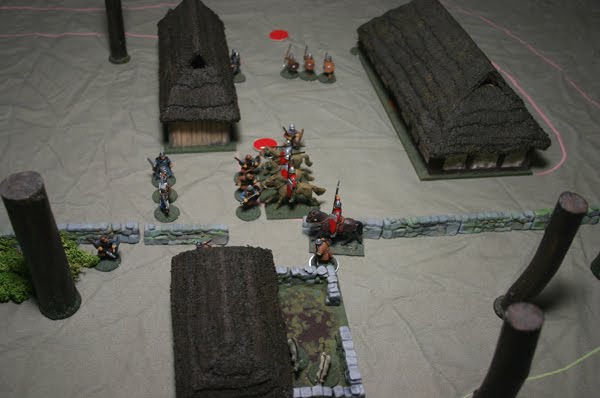
The carriage and the wagon behind it moved off the road to create a barrier to protect von Beyrich's men (see image above), but as the fight had essentially begun, most of the defenders were scattered around outside the protection of the make shift 'lager'. Of the two cavalry riders who had discovered the ambush, one was quickly brought down by arrows and the other sped away as fast as possible up the road. This looked like he was fleeing but he was simply doing what light horse always do; hit n' run. Over the course of the game, whilst the battle raged at one end of the table, this lone rider ducked and dodged at the other end and took out three of Heinrich von Lüneberg's men. He subsequently became the games highest scoring element.


Arrows were speeding left and right as the ambush erupted and the attackers adapted to the situation. Their initial plan was disrupted, but they still had the advantage of longer range weapons and more missile troops. Von Beyrich's arbelstiers attempted to return fire and were moderately succesful, but sitting in the carriage with von Eschenmayer, who was taking pot shots out the carriage windows with his crossbow, Karl Grubenhagen was simply biding his time. When the attackers shot up the carriage, killing both horses and its driver, Grubenhagen took his chance and jumped out.


Suddenly, the defenders realised their prisoner was fleeing and several of the foot soldiers defied enemy arrow fire and attempted to grab the feeling men. Holding the road, von Beyrich became aware of the situation and urged his horse up the slope, but too no avail. Grubenhagen ran like a hare and his rescuers covered him (Grubenhagen can be seen in the upper left of the above image, in a red cloak, running off behind Lothar's skirmish line). The game ended with a victory for Lothar von Schöenberg and his bretheren as they all slipped away into the undergrowth leaving Dieter Anschütz-Kaempfe von Beyrich and his men in total disarray and still wondering who their attackers actually were...

~~~~~~~~~~~~

It was a good game, but brief, and some what predictable. Nonetheless I had fun, and I promise that next time, I will have a thespian intro!


Saturday, October 16, 2010

DSB Part 4. Saving Karl Grubenhagen

The story so far;

2nd June 1409

Rebellion has gripped the eastern provinces of the Deutsche Ordenstaat, and faithful brother-knight Lothar von Schöenberg has found himself at odds with the leadership of the Teutonic Order. Rushing to the assistance of helpless German farmers against the pitiless Lithuanian uprising, Lothar has found his superiors to be largely indifferent to the suffering of their fellow Germans and far more interested in protecting their own assets and those of their holy order.

Now Lothar, his brother Maximillian and their friend Albrecht Mannsfeld have become aware of a conspiracy of silence amongst senior members of the order concerning a massacre in the village of Pinnow. Only one person can help the three knights discover the truth, but Brother Knight Karl Grubenhagen has been placed under house arrest at an out of the way farm near Rudau.

Together with three other like minded Brother Knights; Lorentz Wolfenbüttel, Heinrich von Lüneberg and Jörgen Billung, Lothar, Maximilian and Albrecht decide to gather together a clandestine raiding party and free Karl Grubenhagen. Each of the knights chooses a few trusted foot soldiers from their personal retinue and dresseed nondescript, they make their way to the farm. Upon their arrival however, they are surprised to learn that the farm is being used as a billet for the retinue of a powerful German knight named Dieter Anschütz-Kaempfe von Beyrich and that of another Knight, Adam August von Eschenmayer.

Lothar hesitates for neither of these two knights are members of the Deustche Orden, but are members of the Court of the German King Ruprecht and their presence implies a great many things. Having previously learned from another Knight of the Royal Court, Ulrich von Kunitz, that King Ruprecht is seriously ill and will probably not be able to assist the Ordenstaat in the face of an inevitable confrontation with the Poles and Lithuanians, Lothar realises that he has probably stumbled across circumstantial evidence of a conspiracy between the leaders of the Ordenstaat and high standing members of the Royal Court of Germany. To what end these men have conspired is not apparent, but what is obvious is that only by freeing Karl Grubenhagen will the truth be revealed.

~~~~~~~~~~~~

Map

All terrain is rough unless otherwise marked. Roads are good. Building interiors are filled with gear and furniture, so are difficult.

~~~~~~~~~~~~

Forces

Player One: Oleg

Lothar von Schöenberg (Ritterbruder)
Maximillian von Schöenberg (Halbbruder)
Albrecht Mannsfeld (Diendebruder)
6 x Archer
6 x Skirmisher
Karl Grubenhagen (unarmed)


Player Two: Goeg

Heinrich von Lüneberg (Ritterbruder)
Lorentz Wolfenbüttel (Halbbruder)
Jörgen Billung (Halbbruder)
6 x Archer
6 x Skirmisher


Player Three: Jan

Dieter Anschütz-Kaempfe von Beyrich (Knight)
4 x Spears/cavalry
4 x Arbalestiers
8 x Skirmishers


Player Four: Palle

Adam August von Eschenmayer (Knight)
8 x Spears/cavalry


~~~~~~~~~~~~

Starting

Players one and two may decide what time of day they choose to attack, and they may begin in any order, in any round from any edge of the map. Once an element has arrived on the table however, it cannot leave again without being defeated.

Players three and four set up in the farm and may place four sentries each, any where on the table top. All other elements must be inside, or within six inches of a farm building. All elements belonging to players three and four must be on the table top from round one.


~~~~~~~~~~~~

Victory conditions

Players 1 & 2 win by finding and freeing Karl Grubenhagen.
Players 3 & 4 win by preventing them.


~~~~~~~~~~~~

Special Rules

Karl Grubenhagen must be hidden in a building. He is not tied up as his captors regard him as a gentleman and do not anticipate a rescue attempt. He can be freed simply by removing any guards allowing him to run for it

Players three and four may place four sentries each, any where on the table top. These can be hidden, using the standard stealth rules.

There are six horses tethered in the farm house and eight more around the courtyard. The later can be mounted at the cost of five rounds, from the moment the alarm is given

There are four pigs in the sty they may raise a slight noise if disturbed. Their perception is +1.

~~~~~~~~~~~~

Write up

This game was played on thursday 14th Oct. 2010.
Participants were; Oleg, Goeg, Jan & Palle.

The Teuton's decided to approach the farm under the cover of darkness, then attack using the early morning sun as blinding cover against enemy archers. This plan seemed sound, but it had a slight flaw, von Beyrich had placed sentries outside the farm and one of these was in the way of the approaching Teuton archers. The wind was high and cloud cover almost complete, so when two archers approaching from the east stumbled into the sentry at the break in the paddock wall (see second image), neither side had a clear idea what they were facing and when the sentry jumped around the wall, not sure what to expect, he bumped into an archer who took to his heels and fled in panic.

The sentry realised that something was amiss so he ran back to the farm shouting the alarm. The rest of von Schöenberg's archers quickly shot him in the back however so the people at the farm were unsure as to what exactly was going on.


The table top (with Oleg, Palle & Goeg)

First contact

Von Beyrich's (Jan) men realise something is wrong...

...but von Schöenberg's (Oleg) men are too good at hiding in the dark and remain unseen

Meanwhile, von Beyrich's second hidden sentry who was hiding to the north of the farm and watching the road, was noticed by von Lüneberg's skirmishers as they crept closer across the fields. They tried to shoot him, but missed and the sentry, blinded by the darkness and deaf due to the howling wind, didn't even notice he was being shot at. Only when a second, larger group of von Lüneberg's men approached from the north did the second sentry realise he was in danger. He made a dash for the farm... but was also cut down.

By now the men at the farm were aware that something was up and von Eschenmayer wasted no time. He ordered his men to saddle up and ride straight for the enemy. Which they did. Von Eschenmayer and two of his cavalry charged around one end of the farm house and out into the darkness whilst two others tried to go round the other way, jumping the paddock walls as they went and cutting through the trees.

Von Lüneberg (Goeg) launches a diversionary attack from the north

Von Eschenmayer (Palle) sallies forth to do battle with Von Lüneberg's skirmishers

Von Eschenmayer's attack proved to be some what rash however as the paddock walls and von Schöenberg's archers dissolved the second flank whilst von Eschenmayer himself soon got bogged down fighting skirmishers in the dark. Whilst this was happening, von Beyrich was mustering his sleep addled men in the farm courtyard whilst von Eschenmayer's remainig cavalry were still mounting up.

Arrow fire was coming in from multiple directions but von Beyrich and von Eschenmayer's men couldn't see from where. The night was too dark and confusion reigned. Von Beyrich stayed in the courtyard until he had a clear target to attack.

Von Schöenberg then attacked the farm from the south (see image below), approaching in a line with flanking skirmishers and von Eschenmayer's remaining cavalry wheeled to engage them.

Having lured many of the guards away, Lothar von Schöenberg launches his main attack on the farm house

Von Eschenmayer 's rear gaurd turns to engage von Schöenberg

Von Eschenmayer was dragged from his horse by von Lüneberg's skirmishers and foot knights and this left the defenders with something of a problem. Von Beyrich was still holding the courtyard which was being attacked by von Schöenberg, but he was also taking fire from the darkness. He opted to clear out the archers then wheel about and attack von Schöenberg, either in the courtyard or from behind, depending on how well von Eschenmayer's remining cavalry held.

Alas it was not to be. The game ended before von Beyrich could carry out his plan.

Von Eschenmayer had been defeated and neither side had a significant loss of forces but essentially it was a victory for the defenders, as their prisoner remained in the farm house.

Von Eschenmayer's initial attack ends in defeat

Von Beyrich charges into the dark to find and kill the snipers who were pestering him

Monday, July 19, 2010

....Monday again


Today's musical inspiration! Thelma Houston - 'Don't Leave Me This Way'

Sitting here thinking of Mette, at home with the kids whilst I have to be here at work... *sigh* Another slow Monday eased with beautiful music. Half the guys at work are on holiday and one or two are leaving for good. Goeg from the Rocketman crew is on his last week and Anna who sits beside me in the office has already gone. Its going to be fucking boring around here without them. I'm not good with change and a lot of the new people feel transient. I always get the feeling that people who arrive after me are less interesting than those who were here before me, though obviously that's not always the case. I'm just not too good at saying good bye to people I like in return for meeting strangers who might turn out to be world class idjits. Its happened before, in one case to such a degree that I couldn't face the daily burden of listening to the same droning monologue of supercilious self-congratulatory stupidity and I simply had to leave or resort to physical violence.

Right now I've just finished correcting some one else's work (because he's on holiday not because he can't do it himself) and next I'm drawing a monkey sitting on top of a giraffe's head, reaching up to grab some fruit or leaves...not sure which yet. The idea is for a logo which deals with people helping each other. Some of the jobs I get asked to do are ridiculously ambiguous and good idea's, which are often hard to come by, as often as not get discarded due to unrelated concerns. I don't doubt this idea will get trashed because people don't like being compared to monkeys or some other such nonsense.

Day dreaming too... Autogyro design's... Condottieri in the sunlight... PBY Catalina... heavy breasts... Operation Herald... Momentum vs velocity... He's still alive but I'll probably never his voice ever again...

I have this office to myself so no one sees the tears.

Thursday, May 20, 2010

Robin Hood


Dir: Sir Ridley Scott

After we'd been in to see 'Kingdom of Heaven' in 2005, Oleg, Tracey and I were walking back through the city on a pleasant warm evening. I remarked, "All we need now is for Ridley Scott to do Robin Hood... ", my reference being to our first true skirmish campaigns. Robin Hood and Robin Hood II.

2010 and hey presto; Sir Ridley (a.k.a. The Last God of Cinematography) has answered my prayer and given us yet another precious historical movie set in one of my favourite historical periods. Granted this is not an accurate portrayal of the history of that period, but given what else is on offer, I am more than happy to accept this gift from an aging director with a great many projects planned, and precious few years to accomplish them all. Not even an itchy eye ball could keep me away!

Okay, so now I've gotten that off my chest; what was wrong with this film? The main problem I felt was the rushed story. I didn't mind the premise of who Robin Hood was in this film (half the time it didn't actually feel like a story about Robin Hood at all but rather some other bloke who'd been confused for Robin Hood) but I felt the story telling was a bit glossed over in parts, perhaps due to time constraints. Its possible that like 'The Kingdom of Heaven', this film will see an extended directors cut in a few years time that will rectify the problem of the rushed story telling, and I can live in hope until then; certainly the DC of TKOH is a far better film than the the cinematic release.

Some people have said that this film is superfluous, that essentially is not about Robin Hood at all, but how Robin Hood came to be Robin Hood and for some reason this invalidates the premise of the film. I disagree with that entirely. As Oleg pointed out, what is the true story of Robin Hood? A man with a bow, in Sherwood Forest?

I found remarkably few things to whine about. I liked what I saw. Certainly there were a few jarring details, such as the D Day style (and totally fictitious) French invasion, and Robin's father being hinted as being the architect of Magna Carta, but these were minor abstractions, not worthy of irritation when considered beside the humour, good acting and generally excellent cinematography and art direction.


And then there was the ambiance! Not quite, truly medieval (not a hose in sight) but closer than just about any one else has ever come, with a decent budget, I think. Some of the hovels were a bit dodgy, a bit too fantastic, but on the whole, the film looked like a Robin Hood film ought to look, like a fine balance between realism and fiction. Here are a few behind the scenes pictures regarding buildings.

The acting was not brilliant, but it was well delivered and often humorous. Crowe and Blanchett both carried their roles well (in fact I think this is the best I've ever seen from Blanchett since she played Queen Elizabeth, the first time around). It was funny to see two Aussies smooching as English folk hero's.

The best played parts, as I felt, were by Oscar Issac as a very insecure, but essentially manipulative King John and good old Max Von Sydow as the blind Sir William Loxley.


'Robin Hood' gets five stars because it is what it is. Because this is a film I wanted. Because it looked good even if it wasn't fantastic, and because life is too short to stare gift horses in the mouth!


'Gladiator' was released in 2000, 'The Kingdom of Heaven' in 2005 and now 'Robin Hood' in 2010... Sir Ridley is 72 years old now... dare I ask for a film about 'The Battle of Lepanto' in 2015? There's no harm in asking I suppose so...

P L E A S E ! ! ! ! ! !

Tuesday, April 06, 2010

RM6.2 part three. Conclusion

Part Three of this game was played on Thursday 1 April 2010.
Players were Jan, Goeg and Oleg

Part one can be found here
Part two can be found here

The table top in the initial rounds (seen from the West)
Note Oleg has moved the destroyed fieldgun which was blocking the donkey path

Lt Leftbridge-Smythe's second Mk II makes a break for it
trying unsuccessfully to hide in the smoke from the K4 (seen from the North)

Sir John sends a MkII down to tackle the Uzbek K1 which is proving a nuisance for the
advancing British infantry, as the tank moves forward,
Goeg activates an anti tank mine counter
(seen from the North)

Lt Leftbridge-Smythe and a supporting Vickers Mk VIc move to meet the Bolshevik heavy tank assault
(seen from the North)

Goeg's mine fails to incapacitate the tank and Sir John's armoured flank turns to face the second advancing K4 heavy tank as it moves up to engage the Mk VIc on the main road (seen from theNorth)

The height of the battle and the second K4 defeats the Mk VIc on the Main Road
(seen from the East)

Part three began with only three players. Due to Palle's illness and a loss of interest on Tracey's part (and Rasmus still unable to attend), I ended up playing the British side alone whilst Oleg and Goeg played the Bolshevik's. For all that it was a brilliant evening, made all the more pleasant by the lack of diversion. Setting up the table top took the better part of an hour, but since it was Easter, we could start some what earlier and so the game was finished on time (by 23:00).

We had to roll for initiative as we couldn't recall what had been the last move two weeks ago, and Jan won the toss. The British immediately went on the offensive, moving up as many infantry as possible whilst jostling the tanks. The British began to use grenades to clear rooms and any spaces where an enemy might be hiding. This meant the deliberate waste of grenades, but since the British had a large supply of grenades, this didn't signify any great loss of resources, and after all, one prefers to use grenades to clear rooms and spaces in urban combat.

Oleg also decided to begin the game in a hefty fashion and began firing down the obscured-by-smoke donkey trail with the 60mm guns on his K4 tank, he managed to defeat several Sikh infantry who were moving up. Firing blind however, he was unable to disable the Vickers VI which was guarding the trail. Pausing only to move the damaged field gun which was blocking the head of the donkey path (See images above), he then began moving one of his K4 heavy tanks along it. This caused the British to take counter measures and the Vickers Mk VI which was guarding the donkey path and a Vickers Mk II belonging to Lt Leftbridge-Smythe (which was lurking in a ruin off to one side of the donkey trail) were forced to move to avoid being blown to bits. The Mk VI fled into the forecourt of the compound ruin, where it joined the other Mk VI and the Vickers MkII attempted to drive through the smoke, in the opposite direction as the same time as the K4.

Two of Jan's Sikh's had moved along the donkey trail and penetrated the veil of smoke issuing from the Motor Tachanaka. One of these was defeated but the other ran back to warn his companions of the approaching Bolshevik Heavy Tank. Alas, he met a Black Guard rifleman in the smoke and got into a bayonet duel. Both rolled ones and so were left standing in the path of the smoke blinded MkII as it sought to evade the K4. End result; both were flattened by British tank. Alas for the Brits, the move failed to evade the K4 which opened fire on the smaller tank. The MkII was partially knocked out (mobility kill; disables the tracks but leaves the turret working) but able to return fire for a round or so before the Bolshevik infantry nobbled it. With its last round and with a little help from the surrounding Sikh infantry who were lobbing grenades for all they were worth, the Bolshevik Black Guards lost their first heavy tank.

With the donkey path now well and truly blocked, the gravity of the game shifted towards the main road and upper road and Jan moved multiple armoured vehicles in an attempt to dilute Oleg's fire by giving him multiple targets.

Palle had outlined his plan of action against Goeg as the weakest link in the Bolshevik force, so Jan followed the plan and began to attack with everything possible. Sir John Napier had three medium tanks on the upper road and Jan moved these to cover the small path which led across the centre of the map to the donkey path. This path was the only way for a tank to move across the middle of the map and it was guarded by Goeg's Uzbek K1 Light Tank. Sir John's tanks tried to dislodge the K1 which was sheltering behind a wall but despite several well placed shots, the wall gave plenty of cover. Sir John's infantry however, backed by a section of Sikh's, moved forward through the ruins to bring grenades to bear and a Royal Afghan Rolls-Royce Fordson positioned itself in the midst of the ruins to provide more covering fire against the Uzbek and Anarchist forces.

After a short while, Oleg moved a second K1 forward along the main road and Sir John's medium tanks tried desperately to manoeuvre themselves into an advantageous firing position, but to no avail. Jan had moved Lt Leftbridge-Smythe's Vickers Mk II to the head of the main road, but now facing the advancing K4 Leftbridge-Smythe retreated out of the line of fire. This left a single Vickers Mk VIc guarding the main road and the inevitable happened, Oleg blew it away with the K4 as he moved forward faster than Sir John's tanks could bring their guns to bear.

At this point, Rocketman (supported by various other elements) used his remaining four Hero Points and lobbed a grenade onto the back of the K4, defeating it. Effectively, this was Oleg's own idea as he got slightly carried away I think, but I was happy to use the idea (I might have thought of it myself once I'd considered the options) and in effect win the game with a flourish of unrealistic heroism!

With the loss of the K4, the unstoppable tide had turned and the Uzbek and Anarchists began to fall back. Goeg moved the K1 forward in a vain attempt to block the advance of Sir John's armour, but the upper road was left wide open and Sir John headed for the Bolshevik rear. The game finally ended at this point with victory being awarded the the British. The post game damage rolls showed that about half of the British losses were permanent but only one light tank was ultimately lost.

On the whole, I have to say that this game lived up to my expectations. As usual there were any number of things I'd over looked but on the whole the game, played over the course of three evenings was fantastic. Oleg's enthusiasm helped move things along considerably and here's a big thank you for helping out!


Goeg sacrifices the K1 to block the path of Sir John's advance but ultimately to no avail (seen from the North)

Rockeman takes out the second K4, with a little help from his friends (seen from the North)

A concealed Uzbeck tosses a grenade at an advancing Sikh section (seen from the West)

A. Defeated British Vickers Mk II Medium Tank
(Element survived to next chapter as damaged)
B. First defeated Black Guards K4 Heavy Tank.
C. Second defeated Black Guards K4 Heavy Tank.
D. Defeated Uzbeck K1 Light Tank
E. Lt Col Sir John Napier in his Vickers Medium Mk III Tank.
F. Retreating Anarchist vehicles
G. Surviving Black Guards K4 Heavy Tank.
H. Defeated British Vickers Mk VIc Light Tank (Element destroyed)
I. 'Mad Dog' Mitchell's truck.
J. Lt Leftbridge-Smythe in his Vickers Mk II Medium Tank,
followed by a Royal Afghan Rolls Royce Fordson Armoured Car.
K. Second Royal Afghan Rolls Royce Fordson Armoured Car.
L. British Vickers Mk II Medium Tank.
M. Two British Vickers Mk VI Light Tanks
(One has been defeated, but survived to next chapter as damaged)
N. Rocketman lurking in an alley
O. Yuri, Commander of the Black Guards.


Game Over!