Showing posts with label Oleg. Show all posts

Sunday, April 19, 2015

For Sale: Perry ECW Musketeers, Dragoons and Cuirassiers


These figures were bought for our Eighty Years War project, but that was cut short by Oleg's untimely death. Without him, I have no reason nor inclination to continue the project so I am offering these figures for sale. I was going to put them e bay but I am posting them here first in case any one has an interest in them. The figures are in good condition, unpainted and entirely untouched. The price on Perry's site for the figures would be £164 not including P&P. But I am only asking £100 (€138) +P&P.

Included are:
ECW2 Foot command (6 figures)
ECW4 Armoured Pike, with tassets (24 figures)
ECW6 Unarmoured Pike, half helmeted (24 figures)
ECW8 Musketeers firing (18 figures)
ECW9 Musketeers loading (6 figures)
ECW11 Dragoons/Forlorn Hope skirmishing (12 figures)
ECW13 Demi-Culverin (9 pounder gun) with crew (2 cannon + 8 figures)
ECW 15 Cuirassier Command (3 mounted figures)
ECW16 Cuirassiers with swords drawn (9 mounted figures)
ECW 26 Mounted Dragoons (6 mounted figures)

Tuesday, March 04, 2014

RM12.1 The Return of the Black Guards


Conclusion 

This game was played on 22 February 2014.
Players were Jan, Andreas, Goeg and Palle.

For convenience, I shall refer to the left and right flanks as seen from the perspective of the map.

Both sides deployed across their edge of the table with the Black Guards (Palle and Goeg) deploying their tanks at once. Goeg positioned his first tank on the left flank, guarding the forest road, and he placed his second tank on the parallel road, facing towards the bombed out tank factory. Palle placed both his heavy tanks in the open ground of the far right flank, using the trees as partial cover and left his light tank to cover the ruins of the centre. Andreas placed his commander's tank in the trees facing Goeg's tank on the left flank. He left his second tank off map. Jan placed all three of his tanks in the centre ground of the railway siding. Palle and Goeg concentrated their infantry behind the central ruins whilst Jan and Andreas spread their infantry between the centre and left flank. Most all of Andreas' men were on the left flank.

Firing commenced with Goeg opening up a barrage against Andreas' forces on the left flank. Having established that the T-28 was impervious to his K4's guns, Goeg turned his attention to the infantry. He kept up a prolonged barrage that lasted for most of the game and which, despite their using cover to their best advantage, eventually annihilated a large proportion of Andrea's foot soldiers. Jan's Aglatean infantry hesitated for lack of movement points and were unable to move much from beyond their initial starting ground.

 Both sides held their ground cautiously for most of the first half of the game. Palle and Goeg were wary of the T-35's greater fire power, and Jan and Andreas were out numbered. The T-35 dominated the central ground but largely by default as it wasn't really being challenged. Eventually Goeg moved his second K4 heavy tank up the central road but Jan countered this with his light tanks, blocking the road and using the flame thrower tank to set fire to the tank factory building.

Palle edged his two tanks closer up the right flank in order to find a way of combating the T-35, but this was countered by Andreas who brought his second T-28 onto the map, behind the rail workers shack (not actually shown on the map as it was a later addition) on the far right flank. Trying to establish a lethal cross fire was very much the order of the day with both sides having difficulty bringing enough guns to bear to do any serious damage.

With both sides idling in an apparent Mexican stand off, Andreas then played his joker, a Polikarpov I-16 with six underwing rockets and twin 20mm cannon. He deployed his aircraft against Palle's tanks which were close enough together to bring them both within the rockets damage radius. Unfortunately Andreas rolled badly (both sides were plagued with poor dice rolls all day) and the joker failed. Palle continued to edge for a good firing position with both sides trading ineffectual shots across the right flank.

 Eventually Goeg brought his second K4 far enough up the central road to threaten the T-35 from the left. Palle brought both his tanks up and threatened from the right. It looked for a while as if the T-35 might be knocked out, allowing the Black Guards to secure the centre. Whilst this was happening however, Jan's two light tanks were moving in and around the centre with the twin turreted T-26 engaging the infantry who were trying to close on the storage building (even running some of them over) and the Kht-26 flamethrower tank moving right around the left flank to approach from the rear.

The game ended before either side could deliver a decisive attack and the end result was a narrow victory to the Black Guards, largely thanks to the initial bombardment of Andrea's infantry by Goeg's command tank on the left flank.

I think we had a good game and fun was had by all. I missed Oleg's presence, but in a way he was with us in spirit as the tank factory was one of his models I had completed, and then named after him. There will be a smaller follow up game in the next few weeks but Andreas was only with us for the one session unfortunately as he lives in Oslo. 

Saturday, December 28, 2013

Thus endeth the year

Twas an 'annus horribilius' really, in many ways - what with my best friend dying suddenly. I've been in the dumps ever since. I decided to use my spare time over Christmas to paint the big Soviet tanks I bought a few years back. They've been sitting, unassembled and unpainted in the cabinet for so long, that I thought perhaps I ought to do something about them, and its been at least eighteen months since I last painted anything. This brought my old plans of Rocketman adventures with Oleg to mind, and it has not been easy. Top Gear and Jeremy Clarkson's You Tube videos have kept my mind from obsessing, and slowly the tanks have taken form. I don't know if I'll ever use them, but at least they'll look good on their shelf. I'll post some pictures once they are finished.

In the meantime, I've discovered a new band, Au4. I think they are from Canada but I'm not sure.


Monday, April 29, 2013

Team Bravo Two

Without Oleg, and with changing circumstances for the three of us, Palle, Goeg and I have found ourselves left with fewer opportunities for wargaming and role playing. Currently I'm running a role playing campaign which is based loosely on the idea behind Takshendal, but more along the lines of 'The X Files' with a small team of detectives investigating strange, and/or paranormal mysteries. the title, Team Bravo Two refers to this group's radio call sign. The games are designed to be short, each taking place over just a few sessions, but possibly with several mysteries following each other, much like the episodes of a television serial. I'm not as good at the scientific or technical aspects of these games as Oleg was, so I tend towards vague, technobabble explanations. I try to keep as close to scientific understanding as I can but its not easy dreaming up new, plausible explanations behind idea's which have been used and re-used in popular fiction so many times.

It is fun, but there is always the nagging thought of what we might have been doing if Oleg hadn't died. So much has changed now, not least since we're moving on the 18th May. I'm fast approaching an event horizon in my life and I can't see what lies beyond it.


Tuesday, February 05, 2013

Stone thrower


Oleg's wife Tracey asked me if I would build a model of a stone thrower to decorate his coffin. Flowers were considered a tad unsuitable for a man like Oleg, and since we had so many discussions regarding castles and seige engines, I naturally said yes. I've built a great many models with Oleg, but this was probably the hardest, though technically, it was quite easy.

The reason why it was decided to put a stone thrower on Oleg's coffin, was due to the several 'machines' Oleg had built at the annual Moesgaard Viking festival (see below). I never saw any of these engines in real life as I seldom visited Moesgaard (reenactment has never really appealled to me, and after the first few times I decided I'd seen enough of the Moesgaard festival).

The model only took three days to build, but as I was building it, I was ever aware that any previous model would have generated a great deal of Skype chatter between us, with accompanying links to images, videos on You Tube (though we called it V-Tibe due to years of complicated in-jokes). Oleg would have urged me to build a model of a full sized trebuchet (like the one in the video below), though his own creations never reached such prodigious proportions (he would have had time and resources allowed it). Maybe one day I will build such a model... but then, I've been saying that since 2006.


Tuesday, January 22, 2013

Oleg


My old friend and kindred spirit passed in his sleep last night. He was a private person who did not gladly join social media and did not care to share his life with the world in general. Though he was well versed in all matters scientific and technical, he did not care for Facebook or Twitter and prefered to see computers as personal tools for his own personal ends. He would rather go mushroom hunting in the forests than play an online game. He built gaming models as I did, and tents and Viking clothing. He was (as you can see above) a Viking reenactor, and also an avid enthusiast of several other historical periods. He was extremely intelligent, perhaps the most intelligent man I have ever met, but he was also sympathetic, and cared deeply for his friends.

As partners in various projects, we developed our own games and rules (he did the rules and sometimes I helped). We spent a good decade gaming almost every week, and Oleg usually played the key characters in my campaign games. He played Misteline in Takshendal and he helped me develop the ideas in Rocketman. He ran his own campaigns too, one in particular called 'Sheev'dra', ran for about thirty years and we two must have spent thousands of hours laughing and joking on Skype and playing games with each other.

We had mutual friends, some of whom played with us on a regular basis, others we saw less often. He is survived by his wife Tracey and their two sons, Andre and Peter. All of us are in shock and dismay at Oleg's death. I can hardly believe he is gone. I loved him as a brother and valued his friendship above all others. I know I will never find some one whose company I so enjoyed, whose mind I so admired and whose regard I was so proud to accept.

I still love him as a brother, even though I shall never see him again, nor hear the sound of his voice.


.

Tuesday, June 19, 2012

Dwarven Half-tracks


Having completed all my responsible projects (for now); I'm getting back to completing three scratch built, diesel-punk half-tracks which have stood waiting for too long. The models are inspired by Oleg's Sheev'dra role playing campaign, and can be used in possible skirmish games, though the primary reason for their construction was the simple pleasure of building something unusual.The above image shows various parts for the first two models, which are based around a pair of surplus Company B Ford scout cars which I bought a fair number of years ago, but never built once I'd seen how small they were. The trailer behind the gun tractor is meant to be a steam powered automatic mortar but I haven't yet decided what kind of gun the tractor should be pulling. At the moment, I'm torn between a bio-diesel powered howitzer, or a nebelwerfer style multiple-tube rocket-launcher. 


Recon half-track with entirely scratch built tracks and suspension and an enlarged cab for a single driver. Its hard to see, but this model, as shown has over 120 parts. The camo is based on contemporary Swedish vehicles. The colours are a bit strange due to the crap lighting conditions, and the model has yet to be weathered. The figures are Grymm by Hasslefree Miniatures.


Gun tractor. Similar to the recon half-track, but with an even bigger cab and a much bulkier under-carriage. The idea here is two vehicles built by the same group of dwarves, thus sharing some characteristics but being essentially two very different vehicles. The tracks on the gun tractor were bought from Ramshackle Games. I messed about with the image colours because the model was badly lit. I'm still working on the forward wheels and there will be a winch mounted at the front also. I think I'll paint this one in a more a utalitarian grey blue camo scheme.


This model represents a much bigger half-track than anything built in the real world. The idea here is for a double decker IFV with lots of gun ports and armour plating. The shape of the vehicle is based on a 1920's British design by Burford, and it is more or less scratch built. The turret came from Ramshackle Games but I haven't yet decided if it will stay. I may make a turret of my own design, or not. I probably won't. The body is made of a 2mm cardboard inner structure, clad in acrylic and pvc sheets. The tracks are cannibalised from a 1/35 Soviet T-26 tank.

Thursday, December 29, 2011

Where do I go from here?

I got to thinking about fantasy last night, whilst I was sitting next to Vilde's bed with my mind a-wandering. About fantasy and science fiction and how I grew to regard them with either suspicion or actual contempt. Since I was nine years old, when I picked up my first novel 'Tarka the Otter' and began to read, I loved flights of fantasy and the voyages of the imagination which one finds in fantasy and science fiction. Today however I tend to view both genres with a negative attitude, born of having read the same stories too many times in too many different interpretations. Eventually the similarities became too obvious to disregard and I lost interest with the majority of sci fi and fantasy novels published in the last two decades. There was too much dross and not enough silver.


'Tarka the Otter'
was the first book I read, and looking back on it, was probably my first introduction to dedicated fantasy story telling too. Until then, there had been multiple children's television shows which could be described as fantasy, but in this post I'm thinking of how story telling novels have shaped my mind and I think of television in a mostly visual capacity. 'Tarka the Otter' kicked off a childhood obsession in me for otters, and to this day they retain a small but special place in my heart. It also sparked off a fascination with the 'outsider' characters that proliferate in fanstasy novels and which, as a Danish child growing up in North Western England, in the dreary late 1970's and early 1980's I readily identified with. When I read, and re-read 'The Hobbit' a few years later, I shed a few silent tears when I realised that Bilbo Baggins was not real and that I would never cross mist clad mountains in the strange, fascinating company of Dwarves.

That my life was to be mundane seemed impossible to me in those days, for how could life possibly be mundane? There were mountains to climb, jungles to penetrate and wars to fight. Monsters were real and friends were magical and yet, every so often reality would push its drab monotonous face into view and the fascination of my dream worlds became the horror of mere escapism.


I was thirteen when I discovered the role playing games club at school and by that time, I'd been a dedicated science fiction fan for four years, thanks mostly to a series of weekly science fiction films on television, and to a small but coveted collection of novels I'd gathered from the Boy Scouts charity jumble sale book stall which I had been put in charge of. Amongst these gems was 'Wildeblood's Empire', 'Involution Ocean', 'Roadmarks', and 'A Gift from Earth'. I still have the last three on my sci fi book shelf, where only my favourite sci fi novels are to be found (the rest have been packed away in boxes in case I ever move to a home where I have room for the small library I have collected over the years). Each of these novels was unique to me back then. I didn't know that 'Involution Ocean' was really just 'Moby Dick' in disguise, probably because I'd likely never even heard of 'Moby Dick' back then. I didn't know any of the authors by reputatiion and was quite surprised when twelve years later Oleg leant me a whole collection of Niven novels and I realised that 'A Gift from Earth' was a part of a much larger artistic creation. Lookng back on it all, Niven is still one of my favourite authors, though he also began to get a little repetitious after a while. The trick seems to be to read novels by good authors until you notice their foibles and themes, then stop and move on before they become tarnished. I did that with Arthur C Clarke and I've never regretted it.

I also picked up other odd books in those days, books which I would later put into a broader context but which, at the time, seemed wholly novel and unique. 'Moominland Midwinter' was one such book and 'Duncton Wood' was another. 'Moominland Midwinter' quite literally opened my mind in a way which no other book has ever done. Not even 'The Hobbit' could reach out to me in the curiously personal way this novel did. When I read it, it was as if Jansson was describing my mind in allegory. I was Moomintroll and my life was Midwinter. To this day, this book, and its amazingly powerful illustrations, continues to provoke my sense of self in myriad ways and all I have to do is look though its pages to open a window onto my soul.

'Duncton Wood' gradually faded in importance to me, but for a while it was possibly the most powerful novel I'd ever read. The story is almost Shakespearian in its drama and depth, and yet the premise of the novel, with intelligent moles as its characters, is plainly absurd. In those days I'd heard of, but not seen nor read 'Watership Down', so I had a vague idea of the sub-genre but when I read this book, with its dark and bloody tale, I was fascinated and horrified at the same time. It wasn't the talking moles that got to me, I was used to far more unusual things than that, but rather the story itself with its indirect representation of the stranger aspects of human relationships. I knew of incest, political intrigue, etc, but I wasn't used to reading about them and certainly not in the context of a fantasy novel! Looking back, I wonder why this novel should have stuck out so much as it did, for I'd read other stories back then which also featured horrible and grotesque details, such as 'The Mad God's Amulet'. I suppose the difference lies in the charcters having been moles, which until then I'd probably regarded as cute.


'The Mad God's Amulet' was a short but fantastic novel that was both science fiction and fantasy at the same time. Like so many other of my books in those days, I had probably picked it up at a jumble sale and had little idea of it belonging to a collection of inter-related stories. It had a list of other books in the series on the first page but I disregarded this for years prefering to think of the novel as a stand alone tale. Another novel which was similar in a great many respects, and which also belonged to a larger collection of tales, was 'Marauders of Gor' which I had found in a box of old paper-backs at one of the many traction engine rallies my father often took us to. I remember the Chris Achilleos illustration caught my eye and the subsequent story of Vikings vs giant hairy aliens was sufficiently adventurious to get me well and truly hooked and off to WH SMith's to find more books from the Gor series. Norman's books weren't nearly as baroque as Moorcock's, but they were a similar blend of fantasy with science fiction, and for almost a decade I regarded them as some of my favourite novels. Being a teenage boy I was also captivated by the idea of women as sex slaves, though to be honest, it was the story behind the prudish mysogeny that caught my attention, and my favourites in the series were the first novels when the story carried far more weight than Norman's ridiculous ideas regarding women. You can see which novels are the good ones by their cover art. All the first books were illustrated by Achilleos in his prime.

For one of my birthdays in the late 1970's. Some one had given me a pair of children's anthology books with each chapter showcasing a chapter from some novel or other. These two books, one of which dealt with fantasy and the other with science fiction, formed a base from which I began to range, looking for some of the novels featured (I'm still looking for some of them). The first I found was 'Citizen of the Galaxy' and as with so many other books, I was attracted to the protagonist, identifying with him as only a child can do. As far back as I can remember, this idea of a small and helpless character growing, whilst under the protection of a stronger and wiser character was the primary allure of the fantasy genre for me, but eventually it was also the trigger for my eventual disenchantment. The rot set in with 'The Pawn of Prophecy', 'Dragonriders of Pern' and 'The Colour of Magic', all of which I liked when I first read them, but which gradually became horrendous phantoms of doom as I eventually to put them into the context of the fantasy genre. It didn't help that at the same time I was regularly playing Dungeons and Dragons, nor that my mother was attracted to many of the same books and was readily buying them so we could keep on reading.

'The Colour of Magic' was not one of my mother's favourites, but it was probably that novel which issued the coup de grace. I'd become increasingly hostile to the works of Eddings and McCaffrey, both of which were being brought into my life on a regular basis by my mother's growing addiction for fantasy, and both of which I still kept on reading since there wasn't much else to read in those days, but with 'The Colour of Magic' Terry Pratchett exposed the bare bones of serial novels, especially in the fantasy genre, and he took the piss. With his subsequent production of discworld novels, Pratchett became much like the genre he was lampooning, and this only served to heighten my dislike for the genre and his books even more and eventually I lost all interest in fantasy. Only a few classics of fantasy are left on my shelf and even Tolkien has lost the aura of being something readworthy now Peter Jackson has reduced it to mainstream pap.


When you've been playing role playing games for decades, rather than months or years, you can develop a strong sense for quality in story telling. When you read a fantasy book whose ideas feel pedestrian, then you might wonder at the nature of the genre. When I look back at how I felt reading 'Duncton Wood', and that was just a story about moles, then I wonder at all the long lists, family tree's and complicated geography that has become a staple of the brick sized novels of serial fantasy, and sci fi too, I feel as if I have outgrown the genre entirely. As often as not, I feel that when I am reading fanstasy, I am merely reading some one else's role playing game universe, and as complicated and expansive as it might seem, the simple fact is, all the details and faux facts can't compete with the art of telling a good story.

Tuesday, August 02, 2011

Watch tower model by Oleg


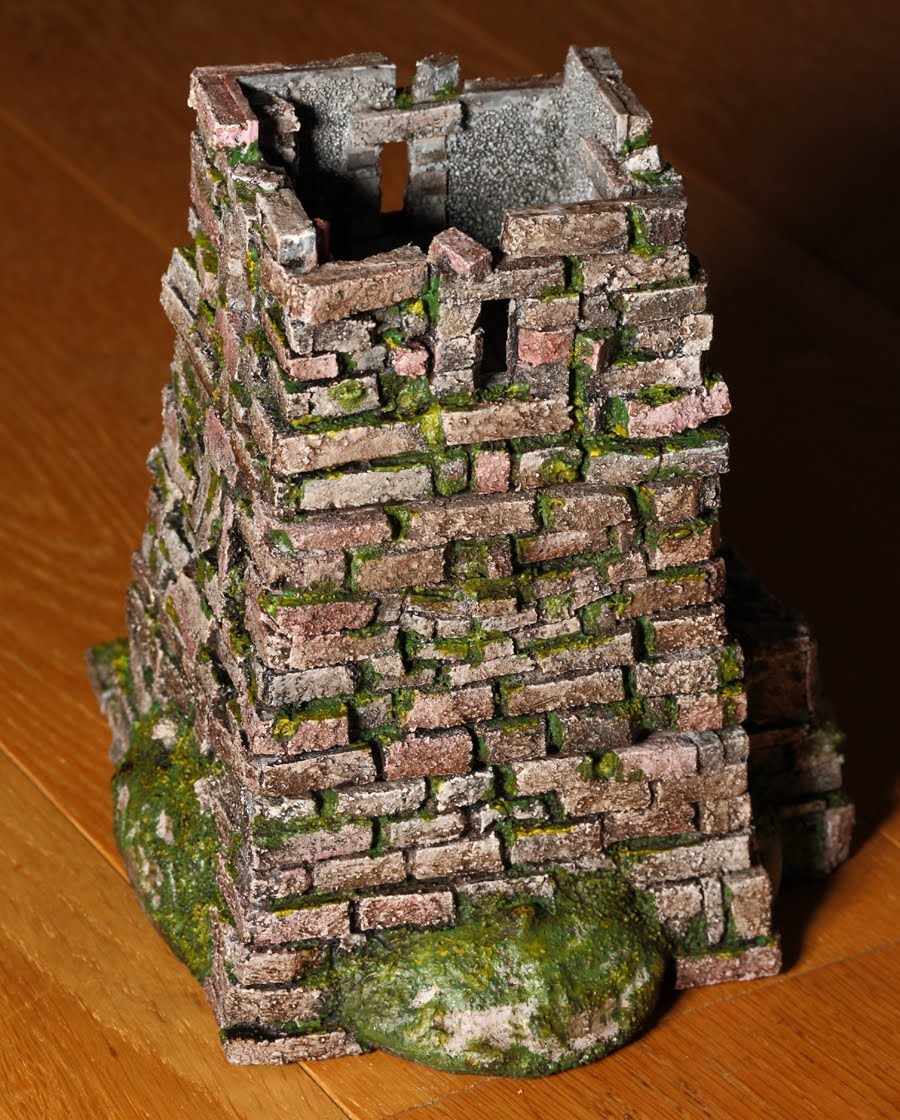
This is Oleg's recently built, watch tower model. It was built over a period of a few weeks, in June and July and is destined to play a part (as far as I understand) in a fantasy role playing campaign. It is a dual purpose model, capable of representing both a well maintained tower, or a ruin. It has no direct historical reference, but the roof is inspired by various Eastern European buildings.

When I saw this model, unpainted but more or less complete, I realised that it demonstrated how to build my Norman style castle without the heavy use of polyfilla. Oleg had built a previous, far larger tower, but that was cylindrical and my mind didn't quite make the connection to a Norman fortification. As soon as I saw this model, the seed which had lain dormant in my mind was watered and began to grow! The image below shows the lower level wall which was my primary source of inspiration.

The basement level; Oleg uses a lot more sand in his models than I do and with this model, the inner walls have been given a coat of sand to provide texture.


All the various component parts, unpainted...

...and painted. Note the basement level features a well and the entrance level features a fire place. There is also a chimney that climbs up through each level.


The roof in progress with its double angle slope and belfry.


The tower in ruin mode; grounded...


...and painted.


Rear view. Note the wall beneath the arrow slot shows signs of having been repaired at some point

Friday, May 06, 2011

Avro Lancaster PA474


Having read on the DR news site that Lancaster PA474 of the RAF's Battle of Britain Memorial Flight was staying the night at Billund airport, Oleg and I decided to go and see it. It had flown over cemetaries the day before to mark Denmark's liberation day, and to salute fallen Allied aircrews and today, according to DR, the aircraft would be open to public viewing between 0900 and 1100.

We left Aarhus at 0900 and got to Billund at around 1020, but there was nothing sign posted, the airport info desk was a mere public computer terminal and the tourist information booth had a herd of zombies standing in front of it. We jumped back into Oleg's car and trolled about for a bit, quizzing a grizzled biker who Oleg identified as a plane spotter along the way. Eventually we found the little hillock where the plane spotters were camped and soon after spied the Lancaster on the far side of the airport. This was a bit of a drag as our time was running out and it meant we couldn't be sure of getting there on time if we drove around. We opted to stay on the hillock and watch from afar with our telephoto lenses. This it turned out wasn't such a bad idea, though we ended up staring across the airport for over an hour, as it meant we were in the optimal position when the aircraft did a fly over of the airport terminal. On the whole it was a very enjoyable little outing, and a most gratifying sight to see such a beautiful aircraft performing a low fly so close by.


Sunday, January 23, 2011

Captain Fouquet; Chapter 1.3 'The Fire Bird' cont...

This game was played on 13 January. 2011.
Present were; Jan, Oleg, Palle, Goeg and Rasmus!!!

The game continued when Misteline and Marmaduke returned to Misteline's apartment where they found Silas who had come looking for his two associates Tom Hurdigrip and Gerald Mosscramp. Neither man had reported back to Silas and he had become concerned as to where they were. Misteline had nothing to tell Silas as he'd not heard from the men since he set them to work. Misteline then proceded to tell Silas what had taken place in the courtyard and how Rufus had come to be imprisoned. Since there were no other witnesses to the duel between Rufus and Franco besides Bagangelo, and since Bagangelo had subsequently been challenged to a duel by Captain Fouquet, Misteline proposed a contingency plan which involved paying some one who might be seen as a credible witness to play such a part. No stranger to respectable clients with large gambling debts, Silas agreed to the merits of the idea and promised to look into it.

Having agreed on their (illegal) plan of action, the three men decided to go to Mossmoore's Restaurant and Social Rooms on Cobblemoss Court, but only after first stopping by the Gentleman's tailoring establishment Van der Viir's to pick up some respectable clothing for Marmaduke. Misteline and Marmaduke went on ahead whilst Silas stayed behind to lurk in the courtyard and see if he couldn't catch some sign of Tom or Gerald. The courtyard was deserted however, and eavsdropping only told him that in one house (the Turnbull's) there was an argument in progress, but not apparently about anything of interest. Silas joined the others and Marmaduke was kitted out in silken undergarments and a plain but well cut outfit of martial design (in black and red). Properly attired the three companions made their way to the restaurant where they ordered food. Silas and Misteline enjoyed a well prepared White Fish whilst Marmaduke tucked into mutton dressed as lamb. Musical entertainment was provided by a small ensemble playing chamber music composed by the illustrious Jacoob de Vert.

Whilst waiting for their food to be served, Silas caught sight of Mister Devar Lockmyrtle, a respectable client of his, who just so happened to be in debt to the tune of 2,000 Crowns. Lockmyrtle saw Silas approaching and to the amazment of his companion Lady Witherspoon, grew some what agitated. He readily agreed with Silas that he would come to the Lotus Flower, the very next day, and there was no need to send any one to help him. Silas returned to the table where his meal was being served. During the course of their desert, several new patrons arrived from the Sun Theatre, including an old friend of Misteline, the actor and poet Alastair Heatherwax. Alastair sat with the companions and entertained himself at their expense for a while, especially Marmaduke chewing mutton whilst looking some what out of place in his painfully new clothes.

Whilst glad times were happening in the Armorial Quarter, Rufus was transferred by armed guard to the city's most formidable (and comfortable) gaol, the Bastion. Here he met an old man named Sir Walter Heraldlamb who had been convicted of debt and corruption twenty years ago and then left in the Bastion to 'rot'. Rufus quickly learned that life in the Bastion, for those who had money could be very lenient, and Sir Walter lived in relative luxury for some one who was supposed to be rotting. Arrangements could be made for food to be brought from outside the prison, visitors were allowed, including women, even prostitutes though not at night unless the woman was a wife in which case she might live with the gentleman so long as she desired. Sir Walter had already eaten but he gave his scraps to Rufus since it was too late to get anything else to eat. It was all a far cry from Mossmoore's where the chamber music had ended and a dancer named Salomé was performing with a snake, to the accompaniment of a Gypsey band. Full of wine and good food, Misteline, Marmdaduke and Silas each departed for home.

12 Marts. 1625.

Marmaduke awoke earliest but he was too slow to see the duel between Anton Fouquet and Bagangelo. He arrived just as the smug and chuckling Captain departed the field of honour, leaving behind him his two seconds to watch the progress of the horribly disfigured artist. Marmaduke pressed closer and saw that Fouquet had made three distinct cuts to Bagangelo's face and as a surgeon attempted to help the poor man, Bagangelo was kicking and screaming in pain. One cut had opened the bridge of his nose, another had lopped off an ear and the third had cut across both lips. Feeling some what sick, Marmaduke retreated from the grisly spectacle and met Silas who had arrived on a horse, accompanied by Tom and Gerald.

Silas paid scant attention to the wounded artist, as he had become aware of Fouquet's seconds, one of whom he was sure he'd seen some where before. He turned to Gerald and told him to stay close to the man and find out who he was. Marmaduke decided to return home and tell Misteline what had taken place, but Silas remained and noticed a fancy carriage off behind some trees. The carriage had no livery, but its presence was enough to pique his interest. Sending Tom to find the debtor Lockmyrtle and bring him to the Lotus Flower he himself followed the carriage back into the city and to the house of a notable member of the Royal Court, Sir Isambard Goatroll. Not familiar with Sir Goatroll Silas was unable to see if the man who climbed from the carriage was indeed the same man, nor did he recognise the lady in fine clothes who accompanied the man. Both were welcomed to the house by the staff as though they were well known, and no one exited the house to greet them. Silas returned home.

Maramduke returned to Misteline and told him what had taken place. Half way through their conversation both heard terrible screams coming from the tower abode of Anton and Anaïs Fouquet. Looking out the window, Misteline saw Meg Plum with three of the Cutlerstub children in the courtyard all looking up at the tower. Misteline decided to go to the apothocary Nicholas Rungate again and ask him to keep an eye open for any one who might be buying the same kinds of compounds as Captain Fouquet. Rungate promised to do this, but expressed doubt that such questions would lead to credible answers since a lot of people bought charcoal and stone salt. Misteline shrugged and inquired whether Rungate might not know of an accomplished surgeon, to which the apothocary replied in the negative.

Misteline went to Milners Lane to see Doctor Hamshank and ask him if he knew of a good surgeon. Doctor Hamshank did and promised to send a message to the surgeon to go and see to Bagangelo's wounds. Misteline then returned to the Friars Gate courtyard where he met and fell into conversation with Mrs Crimpstock and Meg Plum.

Devar Lockmyrtle was shown into Silas's room, sat in a chair and offered a glass of mediocre wine. Still trembling with fear he listened as Silas put forth the proposition where by Lockmyrtle, in exchange for leniency with regards to his debt, would stand forth as a respectable and upstanding citizen and testify that he was a witness to the duel between Rufus and Franco and that the duel had been fair and straight foward. Lockmyrtle agreed.

Once Lockmyrtle had left, Silas pulled on his coat, ordered forth a fresh horse and rode to the Militia offices in the harbour quarter. Here he met with his cousin, Axelrod Underhand whom he had helped install in the position of Captain of the Harbour Militia when he himself had been promoted to Tax Collector (see previous campaign). Since Axelrod largely owed his position to Silas he allowed him to look over the files pertaining to goods imports and Silas subsequently found that Sir Isambard Goatroll was a major importer of gin.

Sometime around midday, Rufus was briefly visited by Marshal Quartermoon who asked if all was well and if Rufus was comfortable and if he shouldn't find himself a servant to do for him? Rufus replied that he wished to speak with Misteline and before leaving Quartermoon told an aide to see to it.

Mean while Misteline and Marmaduke had run into each other in the courtyard and they decided to go and see if Bagangelo had returned home yet. On the way they happened to notice a distinct and bloody hand print on the upper window of Marcus Feathergate's house. Misteline immediately sent an urchin to fetch the militia and whilst he was waiting for the authorities to arrive, the artist went to see Hilda Grimbleflax and spoke with her for a while about 'doing something' about Anaïs Fouquet who it was assumed must be very upset about the duel.


Several Militia guards arrived shortly thereafter and Misteline pointed out the hand print. At first the guards were indifferent, but Misteline persuaded them to break into the house, and (by providing a small contribution to their purses) to take him with them. Within the house they found a mass of old furniture covered in dust coverings, and clear tracks from the doors to the staircase, and upon which they saw another bloody hand print. Upstairs they found the body of Marcus Feathergate.

Feathergate had not been dead for long and whilst the Militia guards searched for lucrative evidence, Misteline examined the body. He found the cause of death had probably been a large wound to the upper head consistent in character to the wounds suffered by Molly Cutlerstub. Most of Fathergate's face was a bloody, blistered mess, with everything burned away above his nose and a sizable wound in his forehead. Judging by the state of the bed, Feathergate had lain dying for more than two days. The Militia guards were not interested in the corpse except in as much as it wore a purse containing 200 Crowns.


Misteline examines the corpse of Marcus Feathergate

Having examined the body, Misteline then turned his attention to the room, plucking papers at random from the writing desk, before noticing two wooden chests. The militia opened the larger, only to find it contained clothing and articles of everyday use whilst Misteline dropped the smaller, locked chest out of the window to Maramduke who deftly avoided the attention of the distracted Militiaman guarding the back entrance to the house. Not long after this, a some what irate Captain Shallowsack arrived and had Misteline escorted from the building.

Misteline and Marmaduke returned to Misteline's studio to examine the contents of the small wooden chest, and as they did so, they noticed a stranger in dark armoured clothing watching proceedings from the archway of Captain Fouquet's tower. Shortly after the chest had been opened, Silas, and Tom, arrived and the three companions examined the neatly stored rolls of paper which were stored inside the chest. Each roll was tied with a wax sealed ribbon and upon breaking the seal, each roll proved to be a seperate cargo manifest of materials of war. Each manifest was dated and each was listed as the cargo list of a single ship. In the early papers the ship's name was always 'Molly Carbuncle', but in later papers a second ship 'Scarlet Jane' was named. The earliest paper was dated 1602 and the last was dated 1624. Seen as a whole, the chest documented the movements of enourmous amounts of war material.

A letter then arrived from Marshal Quartermoon it read;

"Have spoken with your friend, he needs a servant"


Rufus in the meanwhile was served with a summons to a Court of Law, on noon of the 15th of Marts.

Marmaduke eventually tracked down the crest used on the seal and printed at the head of each roll of paper in a book of contemporary heraldry from Misteline's private collection of books. It belonged to a small trading house called Treadstone. Silas recalled the name vaguely from his days as the Militia captain charged with maintaining customs and excise on the River Weyr. He decided to return to Axelrod Underhand's office and left with Tom.

Misteline and Marmaduke departed to speak with the lawyer Nathaniel Pennyfork, but diverted first to hire a man servant at the market. Whilst Misteline was hiring Horace Nuvel, Maramduke noticed they were being followed by the same man in dark armoured clothing whom they had noticed lingering in the Friars Gate courtyard earlier. Maramduke attempted to watch the man clandestinely but the man realised he had been observed. He moved further away but kept Misteline and Marmaduke in sight.

As the sun was dying in the sky Silas and Tom returned to Axelrod's office only to find he was not there. Silas bluffed his way past Axelrod's secretary to gain entrance to the archive room, but Tom ruined the effort by knocking the secretary out cold. Silas found a folder marked Treadstone, but within was only a single legal document stating that all papers pertaining to the House of Treadstone had been removed on the orders of Marshal Leander Quartermoon.


Rasmus made a rare appearance

Monday, December 20, 2010

Planning the Eighty Years War


Over the last six years or so I've gradually bought generic and Rocketman-specific figures, the idea being to provide the props for all the table top games my friends and I have played. I have now, more or less reached the point where I can provide elements for most bog standard medieval or fantasy war games, providing for four players with roughly twelve elements per player. There are a few gaps of course, I have more armoured than unarmoured figures, and I don't have any cannon or hand gunners yet, but on the whole I'm more or less covered now and I'm pondering the next ten years... Where to go next?

Most of our games have been small scale skirmish games. This is because our interest in table top war games grew out of role playing, which we have all played for many years (over a century if you add them all together).

Over the last five or six years then, we've played any number of games, some of which have been quite large and ambitious (by our standards). What we've never played however, is historical battles. All that is set to change now. My funding is limited and my time frame extends over the course of the next five or ten years but for some time I've been pondering building up an historical army and I've had several candidates in mind.

Imperial Romans were my initial thought, because I've always loved that period, and because I found Iron Mitten's Roman blog posts to be very inspiring. Samurai of the Sengoku period were my second thought as I've always loved Samurai movies and the English Civil War was my third thought as the ECW offers a wide variety of weapons and troop types with masses of literary resources available. Speaking with my friend Oleg however, my thoughts ranged further afield to the Eighty Years War which offers the same choice of weapons and troop types but a much wider variety of forces (and thus uniforms and heraldry). The EYW also offers the chance to explore naval battles using galleys and carracks, which in 28mm means building (and finishing) those models I began a few years back.

As of yet, I've not decided on what I'll focus on, but I'll probably be the Protestant Dutch (with English allies?) against Oleg's Catholic Spanish.

Friday, December 17, 2010

Captain Fouquet; Chapter 1.2 'The Fire Bird' cont...

This game was played on 15 December. 2010.
Present were; Jan, Oleg, Palle & Goeg.

Misteline, Rufus and Marmaduke returned to Misteline's studio around an hour after night fall and tucked into a delicious fish prepared in wine sauce, served by the ever present Mrs Crimpstock. After the meal had been devoured and the plates had been cleared away, the companions set about theorising. Misteline expounded on his thoughts regarding alchemy and the purchase of alchemical materials, whilst Rufus advocated a thorough investigation of the mysterious Captain Fouquet. Marmaduke remain taciturn, watching the rain begin to form drops on the window.

Eventually, Misteline and Rufus decided to go and visit their former companion Silas Underhand whom they imagined might be able to assist their inquiries and shed some light on Fouquet's background. Marmaduke, who didn't know Underhand opted to remain in the studio and keep watch on the courtyard in case any further strange events took place. The first thing he noticed was the absence of the militia guard from the south tower door.

Silas Underhand was once a Captain in the City Militia, (See Campaigns 1 & 2) but who was forced out of his position by the change of regime and accusations of corruption. He survived these accusations and set up as the proprietor of the gambling house the Lotus Flower. As a consequence of his career, Silas has a great many contacts in the city's dark under belly.

Misteline and Rufus were admitted by the doorman and greeted by Silas in his chambers. Wine (of a mediocre quality) was served and Silas listened to Misteline's tale. Silas agreed to help in return for being in on any advantages Misteline's investigations unearthed (though Misteline was prudently vague about the mysterious cause of Molly Cutlerstub's death). Silas also agreed to lend Misteline the use of two of his associates. These were the muscular Mr Tom Hurdigrip and the sprightly Mr Gerald Mosscramp. Both men were at hand and accompanied Misteline back to his quarters. Rufus remained at the casino and gambled away some of his money.

Back in Misteline's studio, Marmaduke grew bored sitting in the dark. Two hours had past when he suddenly noticed two dark figures below. Two men in cloaks entered the courtyard from North Wall Street and paused to observe their surroundings at the rear of Meg Plum's house. Marmaduke realised the two men were in fact Meg Plum's lodgers, Cristobal Sebastiano and the man known only as Franco. He watched as the two men moved across his line of vision until they were obscured by the house of Robert Ladlevane. Cracking open a window he heard nothing until a few minutes later he became aware of voices and spied two dark figures standing outside the rear door of the Cock-a-doodle club confronted by the man named Franco who appeared to be threatening the two dark figures with a rapier. Marmaduke reasoned the two dark figures were paederasts and this conclusion was strengthened when both fled into the Cock-a-doodle club. Franco vanished from view. A few minutes later, several figures emerged cautiously from the gentleman's club and peered about the dark courtyard, then all disapeared back into the club.

Misteline returned home, accompanied by Tom Hurdigrip and Gerald Mosscramp, and Marmaduke told him about the confrontation with the patrons of the Cock-a-doodle club. Mosscramp immediately went down into the courtyard to investigate but found it deserted. Misteline then set Tom Hurdigrip and Gerald Mosscramp, to keep an eye on Cristobal Sebastiano and Franco, and both men then departed promising to report back on the morrow. Marmaduke retired to his own home and eventually fell asleep and Misteline sat by his window with a sketch book, musing.

Some time approaching midnight, just as he was beginning to fall asleep, Misteline heard dim voicees raised in argument. Putting his head out of the window he concluded that high above him, in the north tower, Anton Fouquet and his wife Anaïs were engaged in a domestic dispute. Not long after this Misteline observed the old captain leave the north tower and enter the south tower.

11th Marts. 1625.

Misteline was awoken by Mrs Crimpstock bearing his breakfast on a tray. It was sometime after 8 o'clock and outside, it was raining. After breaking his fast Misteline made his way to visit Meg Plum. Surrounded by Molly Cutlerstub's many children, including Nicolet Cutlerstub, the old char lady listened as Misteline expressed his sympathies (and offered a few Crowns to ease their pains). Misteline was interested in understanding Molly Cutlerstub's movements and moods in the days preceding her demise, but the family were unable to help. They had not noticed anything unusual in Molly's daily routine, certainly nothing they could connect with her death. The only detail Meg was able to recall was Molly's reticence during the evening of her last day.


Click to enlarge

Disapointed, Misteline asked the family to keep an eye open for anything untoward and then left Meg Plum's house, making his way along Garnet Street to Cobblemoss Court which he found full of people going about their business. Here he bought a copy of The Gentleman's Companion (one of the many single sheet Journals of Public Record which are a popular source of news and social comment in Takshendal) and found to his amazement that not only was Molly Cutlerstub's death the head line story but the journal was also reporting his involvement in the affair and the existence of an unnamed prime suspect (presumably Marmaduke).

Marmaduke in the meanwhile had awoken and gone looking for Misteline, but in crossing the courtyard had met Robert Ladlevane ignoring the rain and washing his head in a bucket of water. He also saw Anaïs Fouquet exiting the north tower with a wicker basket and head out onto North Wall Street. Marmaduke stayed and chatted with Ladlevane for a while then looked in on Mrs Crimpstock, and then Meg Plum as he followed Misteline's trail.

Independently of each other, Rufus and Marmaduke found Misteline standing in Cobblemoss Court engrossed in reading The Gentleman's Companion and since neither had yet eaten, they dragged him into the Red Fox for coffee and pastries. Having read the paper, Misteline and Rufus headed for the City Hall where they hoped to find archived information regarding the Friars Gate property.

Marmaduke made his way to Misteline's studio but along the way he encountered Bagangelo who seemed to be in a passion and who asked if Marmaduke might happen to know the where abouts of Misteline. Marmaduke replied he had just seen Misteline in the Red Fox and Bagangelo hurried away in that direction.

After two hours Misteline and Rufus were told the address of an old city archive which might be of use but by this time it was midday and so they returned home to rendezvous with Marmaduke who was still keeping watch from Misteline's studio. Marmaduke had nothing to relate as his vigil had been uneventful, though he did mention having seen Bagangelo seeking Misteline and Anaïs earlier in the day. Mrs Crimptock then served luncheon.

As they finished their meal, the companions were delighted at the arrival of Hilda Grimbleflax and Kit Kindle who came to see Misteline to express their solidarity with Molly Cutlerstub's family and to offer a reward of 100 Crowns to any one who might provide information which led to solving the mystery of Cutlerstub's death. Both women were convinced Molly Cutlerstub was murdered but had no understanding of how or why. During this conversation, Marmaduke was still sitting by his window post and noticed Anton Fouquet leave the south tower and cross the gatehouse to the north tower. He drew this to Misteline's attention and the old artist quietly wondered whether the former captain had slept in the south tower all night after the argument which Misteline had overheard during the night.


Franco

Hilda Grimbleflax and Kit Kindle departed and the companions pondered their next move. Misteline decided to seek out Bagangelo so the companions made their way downstairs and into the courtyard where the sun was beginning to shine. As the three men left Mrs Crimstock's house, they saw the mysterious man named Franco exit Meg Plum's house with a drawn rapier and a sharpening stone. As the man kicked a stool into place and sat down, Rufus made a insulting comment refering to 'people who needed to bully homosexuals to feel like men'. Franco understood the nature of the comment but didn't know what the word homosexual meant. He stood up and demanded an explanation, which Rufus subsequently supplied. As Misteline and Marmaduke looked on, Rufus goaded Franco into a duel and the unfortunate southerner drew his rapier and adopted a fencing stance. Within seconds their blades flashing in the sunlight the two men were duelling hard and the outcome seemed uncertain, but then Rufus gained the advantage and ran his opponent through the stomach. Franco dropped to the ground bleeding profously and groaning in agony.


Meg Plum flew out of her house and cried out in despair. Behind her Molly Cutlerstub's children looked on with wide eyes. Plum dropped to the dying man's side and tried to help him, but Misteline advised her not to move the wounded fellow for fear of causing more damage to the wound. An urchin was sent for a local doctor, and Bagangelo arrived whilst Franco spat curses at Rufus and swore he would be revenged. Rufus remained aloof and merely watched as Franco gradually bled out his lifes blood. A second urchin was sent to find Silas Underhand. By the time Doctor Hamshank of Milners Lane arrived, Franco was dead and a small crowd of onlookers had gathered. Several of the inhabitants of the Friars gate Property had also arrived, including Captain Fouquet, Mrs Crimpstock, Robert Ladlevane and from the gate house, Anaïs Fouquet looked on.

Misteline realised that Rufus was in a precarious situation since he had killed Franco without the other man having had any seconds to provide corroboration that the duel had been consensual. He asked around and disovered that Bagangelo had been sitting on his balconey and had seen enough of the exchange to vouch for Rufus's explanation. Misteline then sought the advice of Captain Fouquet but was surprised to see a strong involuntary, emotional reaction pass between Captain Fouquet and Baganagelo, both of whom then tried to supress themselves. Captain Fouquet advised Misteline to either seek a good lawyer or illict any other form of influence he might be able to find on Rufus's behalf. Misteline couldn't think of any good lawyers off hand so he decided to seek out the City Marshal Leander Quartermoon wth whom he had had previous dealings. Misteline rushed to his studio to find some money for bribes then after handing this to Rufus, he made off for the Citadel as fast as his legs could carry him.

Marmaduke and Rufus were left in the courtyard with a waning crowd of onlookers awaiting the arrival of the militia whom they supposed would soon be along. They observed Captain Fouquet and Bagangelo talking to each other ernestly whilst Bagangelo's apprentice Oliver Tapprattle tried to calm the two men down. Suddenly Fouquet punched Bagangelo in the face and the artist staggered back, then replied with an open handed slap to Fouquet's face. Enraged the old sea captain challenged the artist to a duel and Bagangelo accepted. The duel was set for the dawn of the 12th, behind the Dancing Badger public house on the Rogate Road (outside the city). Both men then departed the courtyard, Fouquet displaying an angry counternance as he kicked one of Molly Cutlerstub's children out of his path. He slammed his door behind him as he disapeared into the north tower.

The urchin sent to find Silas returned with a note which read 'Find a good lawyer'.

Two militia guards walking along North Wall Street noticed the crowd of onlookers cluttered about the Friars Gate gate-house and investigated. When they realised there had been a killing, one hurried off to find Captain Shallowsack whilst the other one questioned people as to what had taken place. Rufus explained there had been a fair duel of honour, but his only witness at hand was Marmaduke.

Misteline reached the Citadel and managed to bribe his way in to a meeting with Marshal Quartermoon. By great fortune, the commander of the city militia was watching his men training in the central courtyard of the Citadel, and by even greater fortune, he was happy to meet wth Misteline and hear his story. Quartermoon listened with sympathy and promised to look into the matter personally. He knew the name of Cristobal Sebastiano and asked an aide to find out who the name belonged to. The answer was quick to return, Cristobal Sebastiano was an Envoy to the Royal Embassy of Serrenisma. Quartermoon expressed his concerns at this development and gave Misteline the name and address of an excellent lawyer; Nathaniel Pennyfork of Hedgecote Road.


All the children are Molly Cutlerstub's offspring

Captain Shallowsack arrived with eight militia guards and questioned Rufus and Marmaduke. When he'd heard their story he arrested them both and brought them to the Eastern Wall Militia Tower where they were placed in a cell on the top floor.

Misteline arrived at the house of Nathaniel Pennyfork who agreed to a preliminary engagement to Misteline, on a retainer. Pennyfork undertook to investigate the matter and was confident of success, providing the dead man wasn't important. When he learned that Franco was the body guard of an Envoy to the Royal Embassy of Serrenisma, Nathaniel Pennyfork foresaw certain 'complications' depending on how belligerent the Envoy might be. Misteline expressed grave doubts that Cristobal Sebastiano would look kindly on the death of his body-guard.

Misteline set off for home around the same time as Captain Shallowsack returned to the cell holding Rufus and Marmaduke. He released Marmaduke explaining that the dead man was a body-guard to an Envoy of the Royal Embassy of Serrenisma but another witness (presumbed to be Bagangelo) had provided corroborating evidence which put Marmaduke in the clear. Rufus was left under detention but still retained gentlemen's privilges and his money. (His weapons were confiscated of course).

Misteline and Marmaduke met at Misteline's studio and brought each other up to date. Misteline was disapointed to hear about Captain Fouquet's challenge to Bagangelo, not least since Bagangelo was the only independent witness to Rufus's duel with Franco. Misteline suggested they immediately secure Rufus's apartment so they rushed over to the fencing school and Misteline searched about for any valuable Rufus might have had hidden away. It didn't take the cunning old artist long to find the secret location of his friend's funds and once these were secured, the door was locked and Misteline and Marmaduke descended to the Red Fox for somethng to eat. Hilda Grimbleflax joined them and Misteline learned the details of Bagangelo's confrontation with Captain Fouquet. He also learned that the betting was ten to one against his fellow artist.

Some what concerned with the way things were developing, Misteline and Marmaduke sought out Bagangelo in his apartment. Bagangelo who had been supping with his apprentice Oliver Taprattle was clearly shaken but retained his cool. He refused to consider an apology and offered no explanation as to the cause of the duel, refering to it only as an affair of honour. Misteline advised the services of a local duel instructor; Raymond Archharper (Rufus being out of the picture) and thanking him profusely, Bagangelo departed.

Once Bagangelo had left, Misteline questioned Taprattle as to the cause of the duel. Taprattle offered to divulge this information in return for an apprenticeship. He had no faith in Bagangelo's chances against the old sea captain. Misteline accepted Taprattle's proposal and the apprentice explained that Bagangelo had been engaged in an affair of the heart with Anaïs Fouquet for the last few months.

Friday, December 03, 2010

Cheer up. It could be raining...

Looking west along Nørregade

These pictures were taken last night, being the early morning of 2nd Dec. 2010. As you can see, Denmark is in the grip of winter again, and as in previous years, we seem to be getting one of those white Christmas's which we were led to believe would never again happen. Global warming or just global clueless? You can't see it in the photographs because they were taken with a long exposure time (about 2 seconds) but the air was full of big fat snow flakes.

Looking south along Gammel Munkegade

I had assumed that the snow would stop traffic again as it did a few days ago, but it didn't. We resolved to drive out to Freja's kindergarten (which is situated in Moesgaard forest) but alas, the car wouldn't start so we decided to take a taxi out there and drive back on the Kindergarten's own bus...

But first we had to pick up Magne at his day care centre which is situated in the middle of Aarhus, about three blocks from home. Mette called in good time to arrange a rendezvous with a taxi with a seat for a small child (timed for 14:50) and off we plodded through the snow.

I was well packed in, but the wind chill between the buildings was wicked and it seemed like the bad luck which had crippled the car was still stalking us. We reached the day care centre and picked up Magne who was a bit whiny, then positioned ourselves to await the arrival of the taxi, and waited... after fifteen minutes, with the cold biting at his face, Magne crapped out and started screaming. I can't really blame him, his nose had started running and once he started crying as well, his face was covered in slimy liquid which with the wind chill must have felt very painful. We wiped his face, and tried to cheer him up, but to no avail. Standing in the middle of the city with a howling child was not fun, and as we'd decided to take a taxi, we hadn't brought a pram or stroller. It became obvious that Magne wasn't going to make it and we decided to split up. I carried Magne home in my arms (he screamed all the way, much to other people's merriment) and Mette stayed to wait for the taxi...

Magne and I made it home and relaxed with bread rolls, milk and You Tube. Magne cheering up once we starting watching funny animal antics and Pocoyo. Mette however was left standing in the cold waiting for a taxi which finally arrived at 15:20. It took a further 15 minutes to reach the xmas party, by which time, all the coffee, gløg (a sort of Danish xmas wine) and food was gone, and poor little Freja was in a pitiful state, believing herself to have been forgotten. Since she has spent the last few weeks practicing a song she was to sing for the occasion, it was particularly hard for her to think she'd been abandoned. Mette told me, Freja was beside herself with happiness when she saw her freezing mother finally trudge up the hill to reach the kindergarten. (Poor pregant Mette). I wasn't too happy about it either as I'd looked forward to seeing Freja sing the traditional 'Sankte Lucier' song. Not sure how its spelled, but its a song which kids sing at xmas whilst holding candles.

We all ended up safe and warm at the end of the day, though we found Freja's feet were soaking wet and freezing cold when she took her boots off. I fixed this by wrapping us both up in a duvet on the sofa with her feet pressed against my legs so she could heat up. We watched 'Emil from Lønneberg' whilst Magne walked about with a pirate pistol and made funny shooting noises.

If you don't know 'Emil from Lønneberg', it is a Swedish children's story by Astrid Lindgren (the grand old lady of Swedish children's literature), and was televised back in the early 1970's. As hero children go, you can't get much better than Emil!

Every one's gone to bed now, and I've just finished the write up from yesterdays Takshendal game. We've switched gaming evenings to Wednesdays as Thursday has become untenable for the foreseeable future. Tomorrow is another day, and now its time for a last track from the Balkans and then off to bed...

Saturday, November 20, 2010

DSB Part 6 'On a Winters Day'

December 17th. 1409.

Act I.
Scene I. On a snow covered hill top.

Howling wind. Enter VON LÜNEBERG, VON NATHUSIUS and two SOLDIERS in armour, muffled against the cold

Von Lüneberg. What a filthy weather is this? Sooth but it freezes the marrow in my bones!
Von Nathusius. An tis but December. My discomfort swells in this chill breeze...
Von Lüneberg. Worthy Justus. Take pride and find warmth in your duty to the Fatherland.
Von Nathusius. Tis not my pride that diminishes in this foul tempest Noble Brother
Von Lüneberg. No indeed... [PAUSES TO STARE INTO THE DISTANCE]
Von Nathusius. What do you spy?
Von Lüneberg. Methinks I see a rider upon yonder snowy road
Von Nathusius. There is a road? In all this bleak wilderness I see but those hovels and trees before me
Von Lüneberg. Look you beyond that rude abode. There is a rider on the road
First Soldier. My Lord I spy two riders.
Von Lüneberg. Two riders? I say! What business is this on a dirty day in Skalvia?
Second Soldier. I can’t see them. Where away?
Von Nathusius. I spy them now!
First Soldier. There are soldiers with them, marching behind.
Von Lüneberg. How many can you count?
First Soldier. Ten or more My Lord. They wear red across their armour.
Von Nathusius. But this man has a good set of eyes!
Second Soldier. I still can’t see them.
Von Lüneberg. What soldiers are these? Death of my Soul if the Poles are running amuck whilst our men sleep in their warmth of their cots, an’ we few stout hearted Germans, duty bound by our honour, love and obeidience, must do away with these dark faced mutineers!
Von Nathusius. Amazing!
Second Soldier. Is that them over there?
Von Lüneberg. Can you make out their insignia by chance?
First Soldier. A yellow mark upon a blue shield
Von Nathusius. But the man is a miracle!
Von Lüneberg. What say you Justus, is it not the badge of the Lithuanian?
First Soldier. They are holding forth at the hamlet below
Second Soldier. Now I see them also. That is Vaclav of Stentzin and his men
Von Lüneberg. Be it so? Tis said he is a mad dog
Von Nathusius. Some say he is mad, others that lesser hate him do call it a valiant fury, but for certain, he cannot unbuckle his distempered cause.
First Soldier. Now I see another group on the farther road
Von Nathusius. Yet another road?
Von Lüneberg. Be it distempered or no, his cause will meet with a scant reward once I drew my sword this day!
Second Soldier. For this will bring a heat to our bones! What’s your gracious pleasure Sire?
Von Lüneberg. Let the Devil damn this Polak’s heart!
Von Nathusius. Lithuanian...
Von Lüneberg. Let the Devil damn this Lithuanian’s heart! I’ll fight till from my bones my flesh be hacked!
First Soldier. I shall rouse the men! [HURRIES AWAY]
Second Soldier. I must attend the call of nature before we advance to war. [HURRIES AWAY]
Von Nathusius. But who are these others which ride up the road?
Von Lüneberg. I know it not, but I fancy they bear blue shields.
Von Nathusius. Curse this wind which waters my eyes. Infected be the air upon which visions lurk.
Von Lüneberg. Vaclav must be meeting with some one. I spy the shag-haired villain himself now. He stands there by yonder hut.
Von Nathusius. He looks ill at ease. See how he casts this way and that, seeking a witness who will uncover his treacherous depravity.
Von Lüneberg. These Poles, they know not the tempered love of Christ and Germany. We shall kill them all or rue the day.
Von Nathusius. [PAUSES] ...Lithuanians My Lord Brother.
Von Lüneberg. A horrible sight!
Von Nathusius. I think the men are rousing now.
Von Lüneberg. The service and loyalty I owe, in deed, it pays itself.
Von Nathusius. Did you not yourself tell me an hour since that you have relinquished your oath to the Grand Master?
Von Lüneberg. Not so, valued Sergeant! My honour remains intact, for I swore my oath before Christ, to the Order, not to those who abase it!
Von Nathusius. A worthy distinction upon my soul.
Second Soldier. [RETURNS] I’m done.
Von Nathusius. Are the men ready?
Von Lüneberg. The sin of his ingratitude even now weighs heavy upon me. What other course to lay is mine? The needs of the Order must be supreme over the needs of the man, no matter his station.
Von Nathusius. I think the men are ready
Second Soldier. I am.

~~~~~~~~~~~~~~~~~~~~~


Conclusion

This game was different from previous games in several ways. First it began with a short 'thespian intro', Oleg playing the part of von Lüneberg and Palle the part of Von Nathusius, whilst I took First Soldier and my brother Peter debuted as a DSB player by taking the role of Second Soldier. Goeg was present but was eventually forced to sit out the game due to illness, other wise we would have had five players.

There was no map at all, the players taking turns to place terrain features on to the table top, once a faint snow clad road had been drawn running length wise across the table (which was smaller than usual due to the snow terrain slowing the elements to a crawl).

Once the terrain had been established, the players rolled to determine who would play which
force. Peter rolled for von Lüneberg and Oleg was his second in command. Goeg rolled for the local Prussians, Palle rolled for Vaclav of Stentzin and I rolled for Radu Puşcaş of Dâmboviţa.

A; von Lüneberg. B; von Nathusius. C; Vaclav. D; Radu Puşcaş.

We set up standing forces and the game began with the Teuton's trudging along the road and fanning out to attack the Lithuanians, and Muntenians who were centered in and around the
largest buildings in the centre of the table. The Eastern Europeans had been meeting, and were engaged in some kind of trade, but both were heavily escorted and the Lithuanians were guarding every approach.


Von Lüneberg took the road, moving the bulk of his force in a turgid column whilst Von Nathusius moved to cover his eastern flank. The Germans were not happy about the Lithuanian skirmishers and Muntenian archers but they pressed on, weathering the constant barrage of missiles and returning fire with some accuracy. The soldiers of the Ordenstaat were better armoured and carried effective crossbows and this told. They whittled down their foes as they moved slowly southward, though some of the forward Lithuanians on the western flank held their own slowing the German advance and keeping the fight managable.

Peter's first game.

The Muntenian commander, Radu Puşcaş was seated upon his horse through the battle, and beside him was another mounted Muntenian, clad in bright clothing and bearing a crossbow (he also had a lyre on his horse's harness). This second rider attempted to ride into the skirmish on the eastern flank, but was brought down by a Teuton crossbow bolt to the head. He died instantly. The Muntenians who were trying to hold the eastern flank were also suffering terribe losses, but as things began to look hopeless, some local Prussians arrived and took the side of the Lithuanians. These were Goeg's elements, but by this time he had left and so the dice decided the local Prussians loyalties. I won the toss so the locals became a relief force for the eastern flank.


The arrival of the Prussian locals meant the defeat of von Nathusius, though being a named character required for another game, he was allowed to survive to fight another day without a damage roll, for this time.

~~~~~~~~~~~~~~~~~~~~~

The end result was a marginal win for the Teutons, who were in better condition by the end of the game, with more elements in some semblence of order, despite the loss of their secondary commander. The Lithuanians eventually retreated into the countryside, Radu Puşcaş and his remaining men fleeing along side them. The Teuton's arrested the surviving locals and put them in chains and began to drag them back to Memel...

~~~~~~~~~~~~~~~~~~~~~


Aftermath

Von Lüneberg and his men trudge from the burning ruins of the peasant farm and return along th the road. After a few hours the weary soldiers and their prisoners come to a crossroads. Wrapped against the cold wind, von Nathusius has walked with help from his men, but his condition has begun to deteriate and von Lüneberg calls a halt to the column as he regards the silent snow covered roads which radiate off into the gathering darkness.
"I am exhaused" von Nathusius grumbles.
"Your head does not look good" von Lüneberg replies. "I wish we had some shelter so you might recover your strength".
He turns to a nearby man-at-arms.
"Heinz, go and fetch one of those treacherous locals".
"What are you thinking?" von
Nathusius asks.
"Memel is still half a days walk at this pace. You will never make it. We should have stopped at the farm but for the
risk of that dog Vaclav returning and surprising us".
The man-at-arms returns dragging a shivering bare headed man.
"What is your name, you!?" von Lüneberg shouts at the terrified man.
"Gutenberg My Lord" the man replies.
"What? Art thou a German?"
The man nods miserably
"But then why did you take up arms with the Poles against us?" von Lüneberg asks in wonderment. The man merely shakes his head and mutters something to himself. He points back down the line and the Brother Knight understands the man is blaming one of his fellow rebels.
"Well, be that as it may. Now is your chance to find some small redemption"
The man glances up, and despite his shivering there is a spark of hope in his eyes that almost moves von Lüneberg to pity him.
"We need to find a place to shelter. The wounded cannot be expected to walk to Memel in these conditions."
Even as von Lüneberg speaks, the snow falls heavier than ever and the man nods enthusiastically. He points.
"That way there is an inn not more than a short way"
"An inn?" von Lüneberg frowns. "A German inn?"
The man nods eagerly, hugging his thin arms to his shivering chest. Von Lüneberg nods to himself then motions for the man-at-arms to drag the prisoner away again.
"It sounds promising" von Nathusius says. Von Lüneberg agrees and soon the column makes its way southards. It takes an hour to reach the inn, but eventually the soldiers see a dim light up ahead. A moment or two later there is another and then a row of windows.
"Finally" von Nathusius groans as the group stops before the facade of the inn. He looks up and reads the lettering which is half obscured by the driven snow. "The Merry Widow"
"Lets hope she is" the soldier beside him mutters.

Von Lüneberg and his men do not stand on ceremony but kick in the door and enter the inn with drawn weapons.
Within they find several people with shocked faces huddled around a fire place.
"Who... who are you?" a fat man in aleather apron asks
"Are you the inn keep?" The Knight replies.
"Yes... Yes I am Albrecht Bauer, are you guests or bandits?"
"I am the District Provost and I am requisitioning this inn under the authority of the Ordenstaat!"
"But you can't..." Bauer's voice whispers as he watches the long line of heavily armed soldiers entering the building.
"Albrecht! Whats going on?" a woman cries as she enters from a backroom.
"Madam." Von Lüneberg holds up a commanding finger. "Calm yourself. We merely require food and shelter for the night". He removes his sopping wet cloak and kicks the snow from his feet.
"Verily" the woman agrees readily as she sees the stark black cross on his chest. "We have plenty of room My Lord. Albrecht! Prepare our finest room for his Lordship at once!"
Starting in surprise at his wife's tone, the Inn keeper shuffles up a flight of stairs and disapears above. Von Lüneberg glances about the room at the civilians who make way before him. He warms his hands at the hearth and looks into their eyes.
"Have you ever known such a winter?" he shakes his head.
One man, gratefully replies, "No My Lord".
There is visible relief at this District Provost's tone, and the room is suddenly filled with voices as people begin to relax again. Most of the Teutonic soldier's disperse to other parts of the building, to find a dry place to sleep whilst the inn keepers wife busies herself in the kitchen. Von Nathusius finds a chair and pulls it to beside his brother knight. He warms his hands at the fire, then leans back in grateful repose. Von Lüneberg has produced an object wrapped in cloth
"What do you have there?".
"I'm not sure. I picked it off the Poles's mules."
"I think they were foreigners"
Von Luneberg shrugs. The package is tied with wet leather string and his fingers are still numb with cold. He draws a poniard and slits the package open. Within is a book of dull metal, its cover wrought in finely worked gold and a locked clasp holding it shut.
"Well, well" von Lüneberg mutters. "What is this now?"
"Can you open it?" von Nathusius asks.
"It is locked, but I'll wager I can break into it easily enough.
Von Nathusius shakes his head slightly. "It would be a pity to break such a fine book"
Von Lüneberg considers this for a moment but then shrugs and passes the book to a nearby soldier.
"Open this."
"Yessir!" the soldier produces an axe and with a single blow severs the lock from the cover.
"Impressive"
Von Nathusius murmurs
"Yes, Hans is a dab hand with his axe!" Von Lüneberg smiles happily, "And look, the damage is minimal".
Ale is brought and the two men sip greatfully, then von Lüneberg places the book on his lap and opens the cover. The first page is blank but for a few strange scribbles in some alien writing. Frowning von Lüneberg turns the page, and then the next.
"What is this?" he wonders. "Moorish?"
"It is Greek"
Von Nathusius replies in a dull voice.
"Can you read it?"

"No."
"Oh..."

~~~~~~~~~~~~~~~~~~~~~